

 Aquariums & Supplies

 Coral Reef Aquariums & Supplies

 Garden & Hydroponics & Landscape

 Ponds & Fountains & Waterfalls

 Drum Pond Filter

 Community

 Help Center
Last Updated: November 4, 2026
Quick Summary
Reef filtration is the set of stages that keeps a saltwater tank's water clean enough for corals and fish. Mechanical, biological and chemical stages each remove a different kind of waste, and a protein skimmer should be sized to your tank's bioload rather than its volume alone.
- Mechanical filtration traps debris and uneaten food before those particles break down.
- Biological filtration relies on bacteria that convert ammonia into nitrite and then nitrate.
- Measure net water volume by subtracting rock, sand and sump displacement from nominal size.
- Match the skimmer rating to your bioload, not the tank volume, and confirm the recommended water level.
- Compare total cost of ownership, including electricity, consumables and upfront price, before buying.
Table of Contents
- Choosing a Protein Skimmer for Your Tank's Bioload
- Sump Setup, Space Requirements and Installation
- RO/DI System for Saltwater Aquarium Water Quality
- Total Cost of Ownership: Upfront Price, Media and RODI Filter Replacement
- Buying Reef Filtration Online: Shipping, Returns and Support
- Ordering Your Filtration Upgrade From AquaDreamUSA
- Frequently Asked Questions
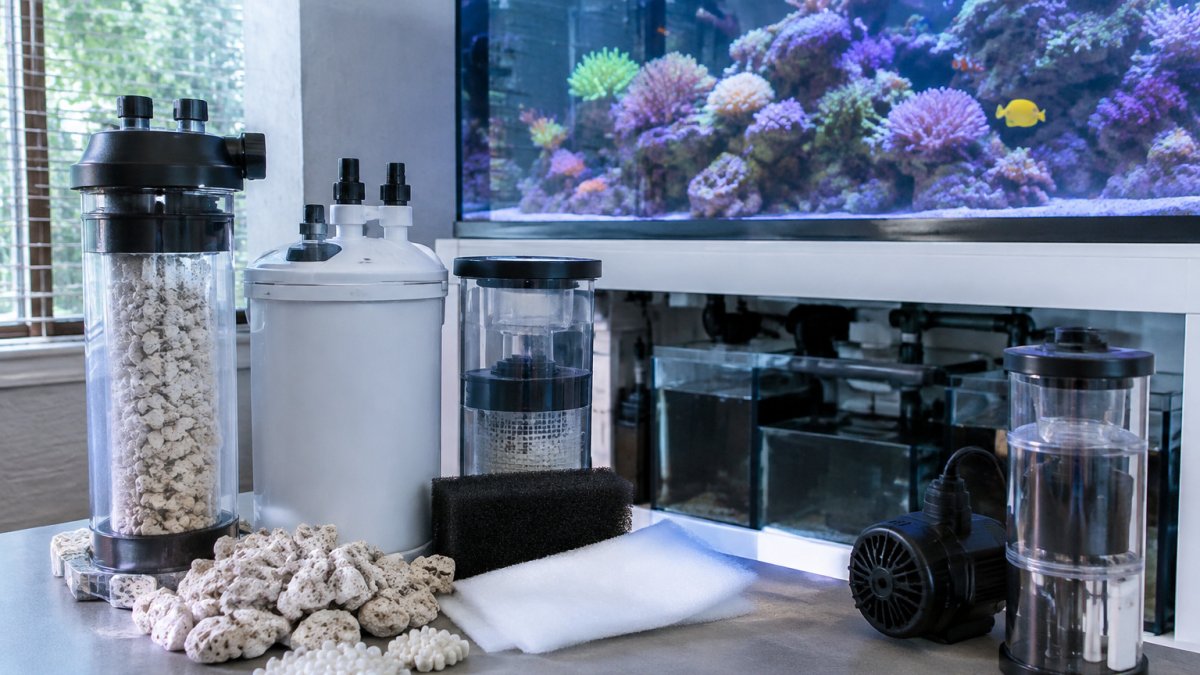
Reef filtration is the set of stages that keeps a saltwater tank's water clean enough for corals and fish to thrive. Each stage removes a different kind of waste: mechanical filtration traps solid particles, biological filtration converts ammonia into less harmful compounds, and chemical filtration pulls dissolved substances out of the water. Understanding how the stages fit together helps you choose the right upgrade.
The reef aquarium market is projected to grow from $9,477.91 million in 2026 to $15,129.17 million by 2034, at a projected CAGR of 6.02% (Straits Research reef aquarium market analysis). More buyers are shopping for advanced equipment, which makes a clear picture of how each stage works more valuable.
Mechanical filtration is the first stage. It removes uneaten food, fish waste and debris before those particles break down and add nutrients to the water. Many reef keepers overlook it, yet it can play a role in nutrient control. A filter sock or roller mat catches material that would otherwise feed nuisance algae.
Biological filtration comes next. Beneficial bacteria colonize surfaces such as filter media and live rock, converting toxic ammonia into nitrite and then into nitrate. This stage depends on stable conditions, so a sudden change in water quality can disrupt it for days.
Chemical filtration handles what the other stages cannot. Activated carbon removes dissolved organics and discoloration, and media reactors can target phosphate. Chemical media needs regular replacement, so factor that into your maintenance plan.
Choosing a Protein Skimmer for Your Tank's Bioload
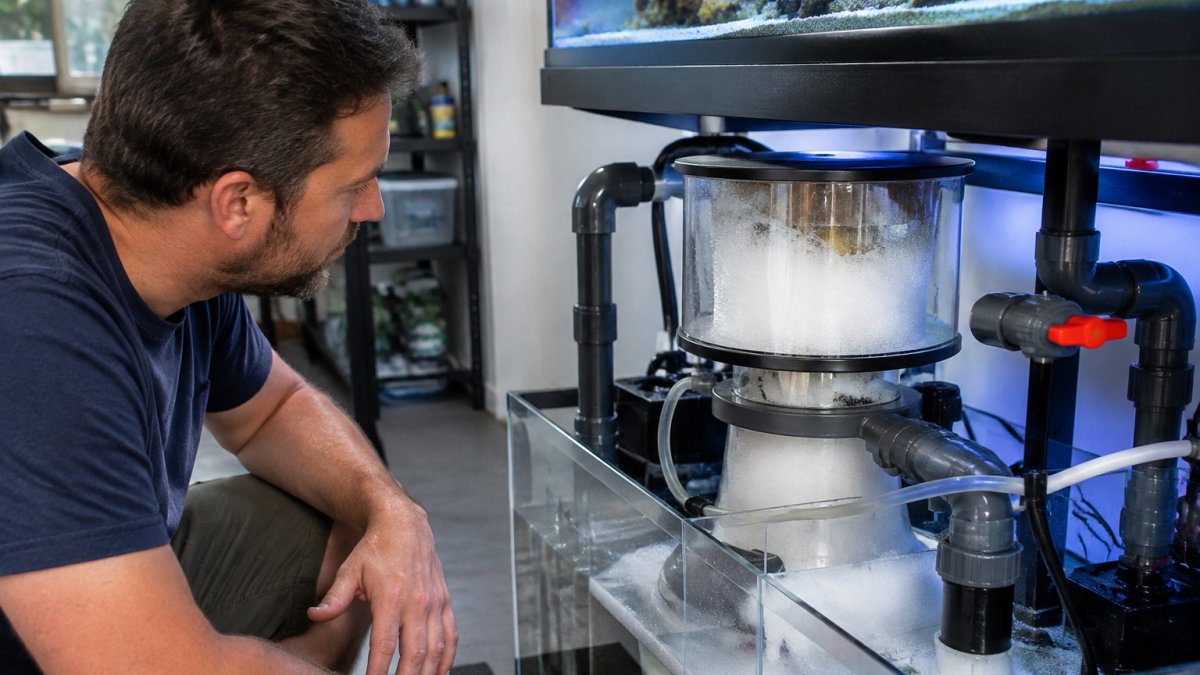
A protein skimmer removes dissolved organic compounds before they break down into nutrients. Matching the skimmer to your tank's bioload matters more than matching it to the tank's volume alone. Heavy bioloads, such as tanks with many fish or a high feeding schedule, need a skimmer rated for a larger capacity. Because a well-matched skimmer reduces the organic load before it fuels excess nutrients, regular maintenance with fish tank cleaning kits can help keep the rest of the system in balance.
A sizing framework you can actually apply
Manufacturer ratings are usually stated as a range for light, medium and heavy bioload. Treat those ratings as a ceiling, not a target. Use this sequence:
- Measure net water volume. Subtract rock, sand and sump displacement from the nominal tank size. A 120-gallon tank with substantial rockwork and a sump often holds closer to 90 to 100 gallons of actual water.
- Classify your bioload. Light means a few small fish and sparse feeding; medium means a mixed community with regular feeding; heavy means large or numerous fish, predatory feeders, or heavy coral feeding.
- Match the rating to the load, not the volume. A heavily stocked 75-gallon tank can need the same skimmer class as a lightly stocked 150-gallon system.
- Confirm the operating water depth. Every skimmer has a recommended sump water level. If your sump runs shallower or deeper, you will need a stand or a baffle adjustment.
- Check the footprint against the sump chamber. Package dimensions include plumbing and the collection cup, so compare the installed footprint, not just the body diameter.
Interpreting the specifications
- Air draw and pump wattage tell you how much foam the unit can generate and what it costs to run continuously. Higher air draw generally supports a heavier bioload, but only if the body is large enough to let foam settle.
- Body diameter and height determine contact time. A tall, narrow body suits smaller systems; a wide body handles higher flow and heavier loads.
- Recommended water level is a hard constraint. A skimmer run outside its range will either overflow or fail to foam.
- Turnover through the skimmer should generally process the system volume several times per hour, but the exact figure depends on the pump and the bioload.
Our AD-N100PLUS, AD-N130 PLUS, AD-N170PLUS, AD-N230PLUS and AD-C7PLUS cover a range of tank sizes.
Matching the lineup to tank size and load
| Model | Listed price | Best fit by tank and load |
|---|---|---|
| AD-N100PLUS | $279.99 | Smaller systems with light to medium load |
| AD-N130 PLUS | $279.99 | Mid-size systems with medium load |
| AD-N170PLUS | $599.99 | Larger systems with medium to heavy load |
| AD-N230PLUS | $599.99 | Large systems with heavy load |
| AD-C7PLUS | $849.99 | Largest systems or very heavy bioload |
Use the table as a starting point, then confirm the operating depth and footprint on each product page before ordering.
Best for: hobbyists with a heavy fish load who want a skimmer sized above the tank's nominal volume.
Skip if: your tank is lightly stocked and fed sparingly, since a smaller skimmer will cost less and do the job.
A skimmer that will not foam is often a sign of a dirty collection cup, a water level outside the recommended range, or a fresh-mixed saltwater break-in period. Check those before assuming a fault. For a step-by-step look at foaming problems, read our guide to fixing a protein skimmer that is not foaming.
The table below summarizes how the stages differ.
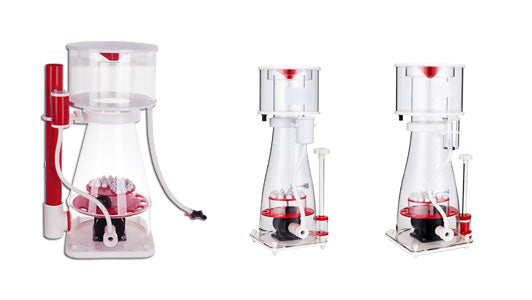
Protein Skimmer 200-500 Gal Ocean Coral Reef Fish Saltwater Aquarium Pump →
| Filtration Stage | What It Removes | Maintenance Need |
|---|---|---|
| Mechanical | Debris, uneaten food, waste particles | Rinse or replace filter sock or roller mat regularly |
| Biological | Ammonia and nitrite, converted by bacteria | Keep stable conditions; avoid cleaning media in tap water |
| Chemical | Dissolved organics, phosphate, discoloration | Replace activated carbon and reactor media on schedule |
| Protein skimming | Dissolved organic compounds | Empty collection cup and clean the needle pump |
Sump Setup, Space Requirements and Installation
A sump sits beneath the display tank and houses filtration equipment out of sight. It adds water volume, gives you room for media and skimmers, and hides the hardware. Before buying, measure the cabinet space, confirm the skimmer's package dimensions, and check the water level the skimmer needs to operate correctly.
Each skimmer in our lineup lists its own product size and package dimensions, so compare those numbers with your cabinet before ordering. A sump that is too shallow for the recommended water level will reduce skimmer performance, so confirm the water depth as well as the footprint.
RO/DI System for Saltwater Aquarium Water Quality
Reef tanks need clean source water. A reverse osmosis unit followed by deionization produces the low-TDS water that most reef keepers use for mixing saltwater and topping off evaporation.
RO/DI filter replacement is a recurring cost, and it protects the quality of every water change. Plan for membrane and resin changes as part of routine maintenance rather than treating them as surprises.
Total Cost of Ownership: Upfront Price, Media and RODI Filter Replacement
The purchase price is only the start. A protein skimmer runs continuously, so its power use, its cleaning time and any wear parts add up over years. Chemical media and RO/DI cartridges are consumables that you will replace on a schedule. Most buyers compare sticker prices and stop there, which is why a simple cost model is worth building before you order.
The four cost buckets
- Upfront purchase price. Our AD-C7PLUS lists a one-time price of $849.99, the AD-N230PLUS and AD-N170PLUS list $599.99, and the AD-N130 PLUS and AD-N100PLUS list $279.99.
- Electricity. A skimmer pump runs 24 hours a day. Multiply the pump wattage by 24, divide by 1,000 to get kilowatt-hours per day, then multiply by your local electricity rate and by 365. A pump drawing 20 watts at a typical residential rate adds a modest but real annual figure; a larger pump on a big system can double it.
- Consumables. Activated carbon, reactor media, filter socks or roller mat rolls, and RO/DI cartridges all have replacement intervals.
- Labor and wear parts. Collection cup cleaning, pump cleaning and impeller replacement are time and money.
A worked comparison
Take two buyers with the same 120-gallon system. Buyer A chooses the smaller skimmer at $279.99 and replaces it two years later when bioload outgrows it. Buyer B chooses the $599.99 unit sized for the eventual load and keeps it for five or more years. Buyer A pays the purchase price twice plus the labor of swapping units; Buyer B pays once. The lower sticker price is not always the lower total cost.
What to check before you buy
- Confirm the pump wattage on the product page so you can estimate electricity.
- Confirm the replacement interval and price of every consumable the unit uses.
- Confirm whether the impeller and venturi are stocked as spare parts.
- Confirm the RO/DI cartridge count and resin volume, since those drive the largest recurring cost in most reef budgets.
Watch out: a skimmer rated far above your actual load will run dry, waste electricity and still need the same cleaning, so oversizing has a cost too. Size for the load you expect within a year, not the load you might have in five.
Buying Reef Filtration Online: Shipping, Returns and Support
Buying filtration online means you cannot inspect the unit before it arrives. Check the listing's specifications against your tank size and your sump dimensions before you order.
Ordering Your Filtration Upgrade From AquaDreamUSA
Start with your bioload and cabinet space, then choose the skimmer that fits both. Our protein skimmers are listed with specifications and one-time pricing, so you can compare options side by side on the product pages. Browse the protein skimmer range to see the full AD-C7PLUS, AD-N230PLUS, AD-N170PLUS, AD-N130 PLUS and AD-N100PLUS lineup, or read our guide to the best protein skimmers for reef tanks before you decide.

Frequently Asked Questions
What filtration system is best for a reef tank?
Most reef tanks run a combination: mechanical filtration to trap debris, biological filtration for nitrogen cycling, a protein skimmer to export dissolved organics, and RO/DI water for top-offs. A sump gives you room for these stages and for media reactors. Match the skimmer and pump capacity to your tank's bioload, and choose the setup that fits your space and budget rather than buying the largest option available.
Do reef tanks need a protein skimmer?
A protein skimmer removes dissolved organic compounds before they break down into nitrate and phosphate. Size it to your tank's bioload: AquaDreamUSA lists its AD-N100PLUS for 35 to 150 gallons and the AD-C7PLUS for 200 to 500 gallons, so the rated range should match your livestock load.
Do I need an RO/DI system for a reef aquarium?
Yes, in most cases. Tap water often contains phosphate, silicate and chloramine that feed nuisance algae. An RO/DI unit produces near-zero TDS water for mixing saltwater and topping off evaporation. Choose a membrane production rate that refills your tank in a reasonable time, and plan to replace the pre-filter and DI media on a regular schedule to keep output pure.
How often should RO/DI filters be replaced?
Sediment and carbon pre-filters typically need replacement every few months, depending on your source water. DI resin should be replaced once its color indicator shows exhaustion or when output TDS rises. Membranes last longer but should be replaced when production drops or rejection falls. Track TDS of your output water with a meter so you replace filters based on measured performance, not a fixed guess.