

 Acuarios y suministros

 Acuarios y suministros para arrecifes de coral

 Jardín, hidroponía y paisajismo

 Estanques, fuentes y cascadas

 Filtro de tambor para estanque

 Comunidad

 Centro de ayuda

Pond Aeration Pump for Murky Water: The Complete Guide
Last Updated: November 8, 2026
Quick Summary
A pond aeration pump for murky water adds oxygen so beneficial bacteria can break down the organic matter and sludge that cloud the water. Diagnose the cause first, then size a diffused aerator to your pond's volume and depth and run it continuously for at least two weeks.
- Test dissolved oxygen and pH before buying any aeration equipment.
- Diffused aeration moves the whole water column and suits murky ponds with sludge.
- A 14W air pump with 4.6 L/min airflow pairs with an air stone disc diffuser.
- Ramp a new aerator from 2 to 4 hours up to continuous over about a week.
- In winter, keep a diffuser near the surface instead of the bottom.
Table of Contents
- Why Murky Water Needs a Pond Aeration Pump, Not Guesswork
- How to Clear Murky Pond Water: A Step-by-Step Process
- Diffused vs Surface Aeration: How the Pump Fits In
- Choosing the Best Pond Aeration Pump for Murky Water
- Small Pond Aeration Pump for Murky Water: What Changes
- DIY Pond Aeration Pump: What You Can Build and What You Shouldn't
- Aeration vs Filtration and Water Treatments
- Safe Startup, Maintenance, and Winter Operation
- Frequently Asked Questions
Why Murky Water Needs a Pond Aeration Pump, Not Guesswork
A pond aeration pump for murky water solves more than a looks problem. Murkiness usually means low dissolved oxygen, stirred-up sediment, or an algae bloom feeding on organic matter.
People often buy a pump before they know why the water turned brown or green, and that order is backwards.
Oxygen levels drive water clarity. A pond with steady circulation and healthy dissolved oxygen supports the bacteria that consume muck and sediment.
Diagnosing the Cause Before You Buy
Three causes cover most murky ponds: suspended sediment, algae blooms, and decaying organic matter. Each points to a different fix.
- Brown or muddy water after rain: suspended sediment. Settle it, then improve circulation.
- Green water in full sun: algae feeding on nutrients. Cut the nutrient load and raise oxygen.
- Tea-colored water with a mucky bottom: decaying leaves and sludge. Aerate the pond bottom.
Test before you spend. A basic dissolved oxygen test kit costs little and tells you whether oxygen is the real problem.
How to Clear Murky Pond Water: A Step-by-Step Process
Clearing murky pond water starts with measurement, not shopping. Follow this sequence and you will buy the right equipment the first time.
- Test dissolved oxygen and pH. Note the time of day; oxygen swings overnight.
- Check the source of the murk. Sediment, algae, or sludge each need a different response.
- Remove obvious organic load. Skim leaves and debris before adding oxygen.
- Size the aerator to your pond's volume and depth.
- Install and run it continuously for at least two weeks.
- Retest and compare. Clarity and oxygen readings should both improve.
Test, Aerate, and Measure
Set a baseline before you install anything. Record dissolved oxygen, water temperature, and a photo of the water from the same spot each week.
Success looks like this: dissolved oxygen holds steady through the night, the bottom stops smelling like rotten eggs, and clarity improves over two to four weeks. If nothing changes, the pump is undersized or the murk is sediment that needs settling, not more air.
Diffused vs Surface Aeration: How the Pump Fits In
Diffused aeration pushes air through a bottom diffuser, while surface aeration splashes water at the top. Diffused systems move the whole water column and are the better match for murky ponds with a sludge layer.
A diffused setup needs three parts: an air pump on shore, weighted airline tubing running to the pond bottom, and an air diffuser. The pump pushes air down; the diffuser breaks it into fine bubbles that lift oxygen-poor bottom water to the surface.
For small setups, a 14W air pump with 4.6 L/min airflow pairs with an air stone disc diffuser to complete the circuit. Surface aerators and fountains work too, but they mostly treat the top few feet.
Choosing the Best Pond Aeration Pump for Murky Water
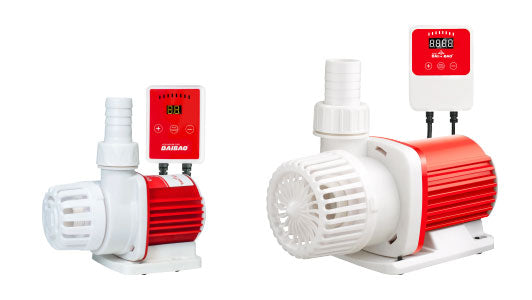
The best pond aeration pump for murky water matches your pond's volume, depth, and oxygen demand. For a typical garden pond, an adjustable submersible fountain and pond pump lets you dial flow to match the water feature.
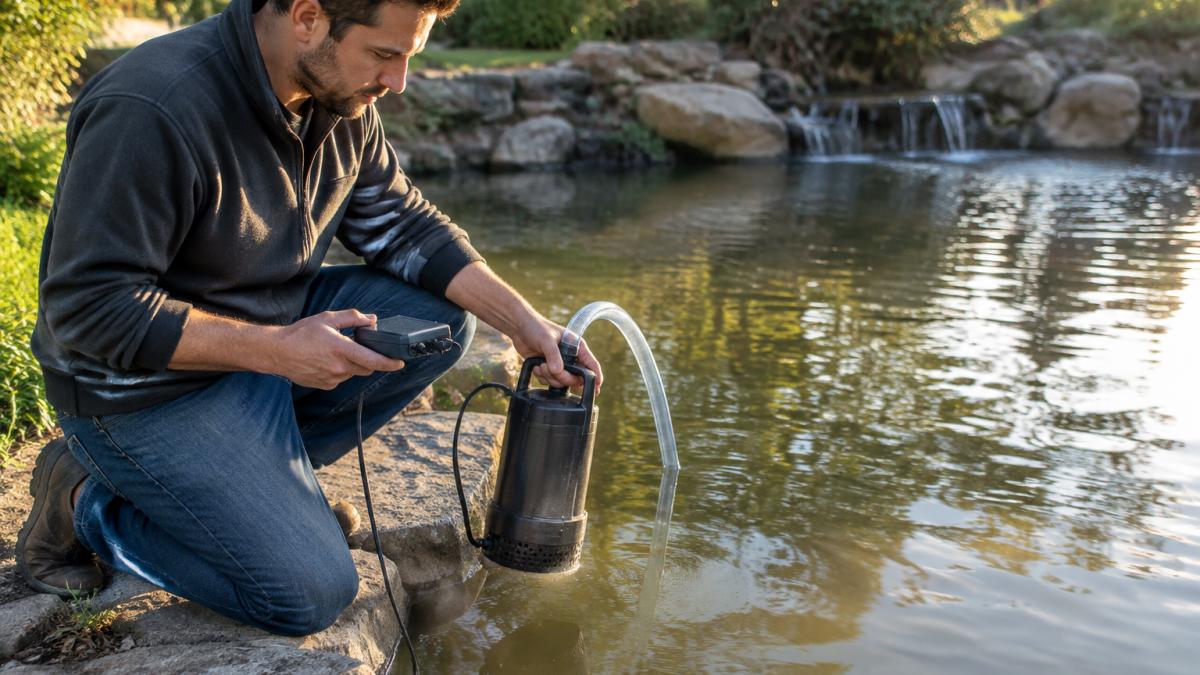
Start with pond volume in gallons, then factor in depth. Deeper ponds need more pressure to push air to the bottom.
The 4230 GPH submersible pump at $219.99 runs on 160W with 20 speed settings, so you can dial flow to your pond instead of guessing. For larger water features, the 6870 GPH model at $330.99 delivers up to 6870 GPH with a 37-foot-9-inch max head.

| Pump | Flow | Power | Price | Best For |
|---|---|---|---|---|
| Aqua Dream 4230 GPH | 4230 GPH | 160W | $219.99 | Mid-size ponds |
| Aqua Dream 5810 GPH | 5810 GPH | 250W | $253.99 | Large ponds |
| Aqua Dream 6870 GPH | 6870 GPH | 400W | $330.99 | Very large features |
Power
Sizing by Pond Depth, Volume, and Oxygen Demand
A practical method beats a rule-of-thumb table. Work through these four steps in order, and write the numbers down so you can compare them after installation.
- Calculate volume in gallons. For a rectangular pond, multiply length x width x average depth in feet, then multiply by 7.48 gallons per cubic foot. For an irregular pond, break it into rectangles and add them. Example: a 12 ft x 10 ft pond with an average depth of 3 ft holds 12 x 10 x 3 x 7.48 = 2,693 gallons.
- Estimate depth pressure. A diffuser sitting 4 ft down must push against roughly 1.7 psi of water pressure (about 0.43 psi per foot of depth); at 8 ft, that rises to about 3.5 psi. This is why a deep pond needs a pump rated for higher pressure, not just higher flow. Check the pump's pressure or head rating against your diffuser depth before buying.
- Match diffuser airflow to volume. A common starting point is roughly 1 to 2 cubic feet per minute (CFM) of air per surface acre for a clean ornamental pond, and 2 to 4 CFM per acre where sludge or a heavy fish load raises oxygen demand. For a quarter-acre pond, that means about 0.5 to 1 CFM as a baseline. Diffuser manufacturers publish recommended airflow per diffuser, so divide total CFM by that figure to get the number of diffusers.
- Adjust for fish load and sludge. A pond carrying more than about 1 lb of fish per 10 gallons of water, or one with a visible sludge layer, should be sized at the top of the range or one tier up. Oxygen demand rises with water temperature, so a pond that tests fine in spring can crash in August.
Depth matters as much as volume.
Watch out: water pumps and air pumps are not interchangeable. Confirm which rating you are reading before you compare models.
A Sizing Worked Example
Take a 1/4-acre pond averaging 5 ft deep with a moderate fish load. Volume is roughly 0.25 acre x 43,560 sq ft per acre x 5 ft x 7.48 = about 40,700 gallons. At 2 to 4 CFM per acre for a pond with fish and some sludge, target 0.5 to 1 CFM total. If each diffuser is rated for 0.5 CFM at 5 ft, one or two diffusers cover the pond, and the air pump must deliver that airflow at roughly 2.2 psi.
Small Pond Aeration Pump for Murky Water: What Changes
A small pond aeration pump for murky water needs less flow but the same discipline. Small ponds heat up fast, hold less oxygen, and swing harder overnight.
For small ponds, a quiet air pump with adjustable output can be a practical choice. The 4-outlet air pump at $76.99 pushes up to 4 x 75 GPH across four outlets and has a steady output with adjustable oxygen levels.

DIY Pond Aeration Pump: What You Can Build and What You Shouldn't
A DIY pond aeration pump can work for a very small water feature, but most homemade builds fail on pressure and durability. You can assemble an air pump, airline tubing, and a diffuser yourself. That part is straightforward.
What you should not build is the pump itself. Buy the pump, build the plumbing.
- Worth doing yourself: running weighted tubing, placing diffusers, building a pump housing.
- Not worth doing yourself: motor repair, impeller replacement, pressure tuning.
- Watch out: undersized airline tubing chokes airflow and makes any pump look weak.
Aeration vs Filtration and Water Treatments
Aeration is not filtration. Aeration adds oxygen and moves water; filtration physically removes particles and nutrients. Murky water often needs both.
If your water stays cloudy after two weeks of aeration, the load is too high for oxygen alone. A high-performance pond filtration system removes the suspended particles and nutrients feeding the murk. For green water driven by algae, a UV sterilizer is the targeted fix.
Think of it as a stack: aeration for oxygen, filtration for particles, UV for algae. Match the tool to the cause you diagnosed in step one.
Safe Startup, Maintenance, and Winter Operation
Start a new aerator gradually, especially in a pond that has been still for months. A sudden jump in oxygen can shock fish that adjusted to low levels, and it can also mix oxygen-poor bottom water into the whole pond faster than the fish can tolerate.
Safe Startup for a Stratified Pond
In summer, many ponds stratify into a warm, oxygen-rich top layer and a cold, oxygen-poor bottom layer. The bottom water can also hold hydrogen sulfide and ammonia that built up while it sat undisturbed.
A gradual ramp-up reduces that risk:
- Day 1: run the pump 2 to 4 hours, ideally in the morning when surface oxygen is lowest and the pond has the most room to absorb change.
- Days 2 to 4: add 2 hours per day until you reach 8 to 10 hours.
- Days 5 to 7: move to continuous operation if fish show no stress. Watch for fish gulping at the surface, which signals low oxygen rather than improvement.
Watch out: if the pond has a thick sludge layer and has not been aerated in years, test for ammonia before startup and ramp even more slowly.
Maintenance Schedule
Check the air filter every six months, as HIBLOW USA recommends in its pond aeration maintenance guidance. Clean diffusers when bubbles turn coarse, since clogged diffusers raise back pressure and shorten pump life. Inspect weighted airline for kinks and UV damage each spring, and confirm the pump housing stays dry and ventilated.
Seasonal Operation and Winter Use
Aeration needs change with the seasons, and the same schedule should not run year-round without adjustment.
- Spring: clear debris before ramping up, because runoff and decaying leaves spike oxygen demand.
- Summer: run continuously, and expect the highest oxygen demand during hot, still weather. Nighttime is when oxygen is most likely to crash.
- Fall: remove falling leaves before they sink; this is the cheapest way to reduce next year's sludge.
Watch out: pulling a bottom diffuser out of a frozen pond mid-winter can crack the diffuser and airline. Set winter placement before the first freeze, and leave it in place until ice-out.
Murky water rarely clears on its own. Diagnose the cause, size the pump to your pond, and measure the results.
Frequently Asked Questions
Will a pond aerator clear muddy water?
It depends on what is making the water muddy. A pond aeration pump raises dissolved oxygen and keeps water circulating, which helps break down organic matter and reduces the conditions algae blooms need. If the murk is suspended clay or sediment washed in by runoff, aeration alone will not settle it. Test the water first, identify whether the cause is organic or mineral, then match the pump and any treatment to that finding.
How long does it take for pond aeration to improve water clarity?
Most ponds show visible improvement in two to four weeks of continuous running, with clearer results over a full season as pond muck and organic matter break down. Small ponds warm faster and respond sooner. Run the pump continuously rather than on a timer during the startup period, and track dissolved oxygen and clarity weekly so you can see whether the system is sized correctly.
Can you put too much aeration in a pond?
Oversized aeration rarely harms fish, but it wastes energy and can churn up bottom sediment in shallow ponds. Match airflow to pond volume and depth instead of buying the largest pump available. For a small pond, a 12W four-outlet air pump like the Quiet Air Pump at $76.99 can provide steady oxygen. For larger ponds, a variable-frequency pump with adjustable speeds lets you dial flow down after startup.
What is the cheapest way to aerate a pond?
A DIY pond aeration pump built from an air pump, weighted tubing, and a diffuser is the lowest-cost route for small ponds, and it works well when the pump is rated for the volume. For larger ponds, a variable-frequency submersible pump lets you adjust speed. The Aqua Dream 4230 GPH pump at $219.99 offers 20 speed settings.