

 水族箱及用品

 珊瑚礁水族箱及用品

 花园、水培和景观

 池塘、喷泉和瀑布

 滚筒式池塘过滤器

 社区

 帮助中心

How Do You Choose a Pond UV Sterilizer?
Last Updated: November 2, 2026
Quick Summary
To choose a pond UV sterilizer, first measure your true pond gallons, then decide whether you need a clarifier dose for green water or a higher sterilizer dose for pathogens, and finally match a unit that holds that dose at your actual flow rate. Slower flow means more contact time and a higher dose, so oversizing the pump is the most common installation mistake.
- Pick a clarifier for green water and a sterilizer only if you accept slower flow and higher cost.
- Clarifier doses run 15,000-30,000 µWs/cm² while sterilizer doses need 40,000+ µWs/cm².
- Subtract roughly 20% from measured volume for rocks, shelves, and plants to get true gallons.
- Plumb the UV unit last: pump, then mechanical filter, then UV, then back to the pond.
- Replace the UV lamp every 12 months, or every 9 months in a heavily stocked koi pond.
Table of Contents
- What a Pond UV Sterilizer Actually Does (and Doesn't)
- Pond UV Clarifier vs Sterilizer: Which One Do You Need?
- Pond UV Sterilizer Sizing: Gallons, Wattage, and Dose
- UV Sterilizer Flow Rate for Ponds: Why Contact Time Decides Results
- Pond UV Sterilizer Installation: Where It Goes and How to Plumb It
- Maintenance, Bulb Replacement, and What It Costs to Run
- When a UV Unit Won't Fix Your Pond
- Choosing Your AquaDreamUSA UV Sterilizer
- Frequently Asked Questions
What a Pond UV Sterilizer Actually Does (and Doesn't)
A pond UV sterilizer uses ultraviolet light to damage the DNA of single-celled organisms that pass through its chamber. That stops algae from reproducing and can neutralize some free-floating pathogens. A UV unit is a water-clarity tool, not a replacement for filtration.
Here's what most guides get wrong. They sell UV as a cure-all. It isn't. The lamp only treats water that reaches it, and only at the right dose.
Clarifying green water versus killing pathogens
UV clarification targets suspended algae, the single-celled green bloom that turns water pea-soup cloudy. UV sterilization aims at a higher dose to neutralize bacteria, viruses, and parasites such as Ichthyophthirius.
These are different jobs with different dose requirements. A clarifier runs a modest dose. A sterilizer needs a much higher dose and slower flow. One unit rarely does both well.
If green water is your only problem, UV will help. The Centers for Disease Control and Prevention guidance on recreational water notes that ultraviolet treatment is one layer of water management, not a standalone fix.
For a full plan beyond UV, see our guide on how to clear murky pond water.
Pond UV Clarifier vs Sterilizer: Which One Do You Need?
Pick a clarifier if green water is your complaint. Pick a sterilizer if you want to reduce free-floating pathogens and can accept slower flow and higher cost. Most garden ponds need the clarifier.
The distinction comes down to dose.
Higher dose generally means less flow through the same lamp.
| Feature | UV Clarifier | UV Sterilizer |
|---|---|---|
| Main target | Suspended algae | Bacteria, viruses, parasites |
| Typical dose | 15,000-30,000 µWs/cm² | 40,000+ µWs/cm² |
| Flow speed | Faster | Slower |
| Best for | Green water, clarity | Fish health, quarantine |
| Cost | Lower | Higher |
Best for: clarity and algae control, choose a clarifier. Skip if: you expect it to cure fish disease.
Pond UV Sterilizer Sizing: Gallons, Wattage, and Dose
Sizing comes down to three numbers: pond volume, target dose, and flow rate. Get those right and the wattage follows. Get them wrong and you'll buy the wrong unit twice. Most guides stop at a manufacturer capacity label; here is the actual math so you can size with confidence.
Calculating pond gallons
Measure length, width, and average depth in feet. Multiply them together, then multiply by 7.48 gallons per cubic foot.
A pond 10 feet long, 8 feet wide, and 2 feet deep holds about 1,200 gallons. Irregular shapes: break the pond into rectangles and add them up.
Subtract roughly 20% for rocks, shelves, and plants. That's your true water volume.
Worked sizing example
Start with true volume, then pick a target dose, then back into flow. Suppose your pond measures 1,200 gallons after the 20% rock-and-shelf deduction, and you want green-water clarification at a modest dose.
- Convert gallons to flow per hour. A common clarification target is one full pond turnover every 1 to 2 hours through the UV chamber. At 1,200 gallons, that is 600 to 1,200 gallons per hour (GPH).
- Check the dose at that flow. UV dose is roughly lamp output divided by flow, adjusted for lamp age and water clarity. A 40-watt unit rated for a clarification dose at 1,200 GPH will deliver a lower dose if you push 1,500 GPH through it. Slower flow means more contact time and a higher dose.
- Pick the wattage that holds dose at your flow. If your pump moves 1,200 GPH and you want a pathogen-reduction dose, you need either a larger lamp or a lower flow. Most practitioners split the flow so the UV chamber sees only the water it can treat at the target dose.
Adjusting for fish load, sun, and clarity goals
Three factors cut effective capacity, and each one should push your sizing decision:
- Fish load. Heavy stocking means more waste, more suspended organics, and more organisms to neutralize. A heavily stocked koi pond often needs the next wattage step and a slower flow to hold dose.
- Sun exposure. Full-sun ponds bloom harder and recover faster after a UV pass. Shade and partial-sun ponds can run a smaller unit at the same dose.
- Clarity goal versus pathogen goal. If you only want to clear green water, a clarifier dose at a faster flow is enough. If you want to reduce free-floating microorganisms, you need a higher dose, which means a larger lamp or slower flow through the same chamber.
Matching UV wattage to pond volume
There's no universal chart. Use the worked method above rather than a single watt-per-gallon figure.
Dirty water entering the unit is the fourth capacity killer. Mechanical filtration first, always, so the lamp's energy hits organisms rather than debris.
UV Sterilizer Flow Rate for Ponds: Why Contact Time Decides Results
Contact time is how long water sits inside the UV chamber.
Match the pump to the unit, not the other way around.
Aqua Dream UV Sterilizer High-Efficiency Water Treatment System for Pools →
You can always split flow: send part to the UV unit and part around it.
Our pond water pumps list their flow ratings so you can match throughput to your UV unit's requirement.
Watch out: oversizing the pump is the most common installation mistake.
Pond UV Sterilizer Installation: Where It Goes and How to Plumb It
Plumb the UV unit last in the filtration chain: pump, then mechanical filter, then UV, then back to the pond. Clean water entering the chamber means the lamp's energy hits organisms, not debris.
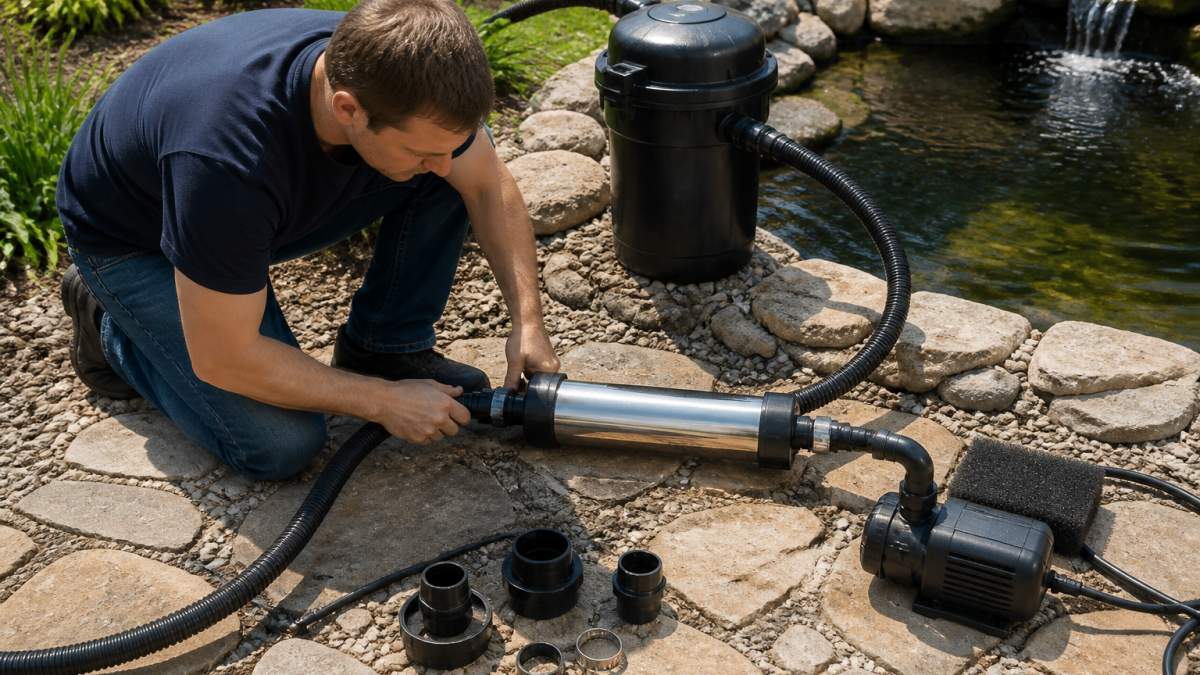
Mount the unit horizontally or per the manufacturer's orientation. Keep it out of direct sun and where you can reach the quartz sleeve for cleaning.
In-line installation checklist:
- Pump positioned at the lowest point
- Mechanical filter before the UV chamber
- Flow tested and matched to the unit's rating
- Electrical connection on a GFCI-protected circuit
- Unit accessible for sleeve cleaning
Safety matters here. Water and electricity demand a ground-fault circuit interrupter, and the U.S. Consumer Product Safety Commission pool and spa safety resources apply the same logic to any water feature with powered equipment.
Maintenance, Bulb Replacement, and What It Costs to Run
A UV lamp keeps glowing long after it stops producing useful UV-C.
Budget for:
- Replacement lamp: yearly
- Quartz sleeve: inspect, replace if scratched or clouded
- Cleaning supplies: a soft cloth and a mild acid for mineral scale
When a UV Unit Won't Fix Your Pond
UV fails when the real problem isn't suspended algae. Murky brown water is usually sediment or tannins, not a bloom. Cloudy white water points to a bacterial bloom from an immature biofilter. Neither responds to UV.
Signs you need filtration instead:
- Water is brown or tea-colored
- Fish waste collects on the bottom
- Ammonia or nitrite readings climb
In those cases, mechanical and biological filtration do the work. Explore our pond filtration systems before spending on a lamp.
Troubleshooting persistent green water
If you bought the right unit and green water still wins, work through this checklist before you buy anything else.
- Dirty quartz sleeve. Mineral film and biofilm block UV like a curtain. Pull the sleeve and clean it every few weeks; if it looks cloudy after cleaning, replace it.
- Exhausted lamp. A UV lamp keeps glowing long after it stops producing useful UV-C. Replace it every 12 months, or every 9 months in a heavily stocked koi pond, even if it still lights.
- Excessive flow. If the pump pushes more water through the chamber than the unit is rated for at your target dose, contact time drops and the lamp cannot deliver the dose. Measure actual flow at the outlet, not the pump label.
- Bypass plumbing. A split flow that sends too much water around the UV unit, or a valve left partly open, starves the chamber. Confirm all treated water actually passes through the lamp.
- Inadequate pre-filtration. Debris and organics shielding organisms from UV, or fouling the sleeve, defeat the lamp. Mechanical filtration before the UV chamber is not optional.
What UV will never do
UV treatment does not remove settled debris, correct water chemistry, or replace biological filtration and pond maintenance. It treats only the water that passes through the chamber, at the dose the lamp can deliver. If your pond has a sludge layer, climbing nutrients, or an immature biofilter, fix those first; UV is a clarity tool that works best on an otherwise healthy system.
Choosing Your AquaDreamUSA UV Sterilizer
Match the unit to your measured gallons. Our UV Sterilizer Series covers three pond sizes, and each one uses chemical-free sterilization in a closed system.
| Model | UV Power | Flow Rate | Price |
|---|---|---|---|
| UV-80 | 80 watts | 7 m³/hour | $829.99 |
| UV-240 | 240 watts | 20 m³/hour | $1,299.99 |
| UV-400 | 400 watts | 35 m³/hour | $1,499.99 |
The 80-watt UV sterilizer suits smaller garden ponds and landscape features. The 240-watt model handles mid-size ponds. For large aquaculture or landscape ponds, the UV-400 runs five high-transmittance lamps with 90 mm inlet and outlet fittings.


Each unit is designed for a closed, contamination-free system with simple installation and maintenance.
Frequently Asked Questions
How do I choose the right size UV sterilizer for my pond?
Start with your pond's volume in gallons, then match it to the manufacturer's rating for the unit. A pond UV sterilizer is rated for a specific volume and flow rate, and you should size to the higher end rather than the bare minimum. If your pond sits in full sun or holds a heavy fish load, go one size up.
What flow rate should I use with a pond UV sterilizer?
Flow rate matters because it sets contact time. Push water through too fast and the ultraviolet light does not have long enough to damage algae cells or microorganisms. Check the unit's rated flow and stay at or below it. For example, the Aqua Dream UV-80 is rated at 7 m³/hour, the UV-240 at 20 m³/hour, and the UV-400 at 35 m³/hour. If your pump is stronger, tee off part of the flow or use a valve so the sterilizer sees only what it is rated for.
What is the difference between a UV clarifier and a UV sterilizer?
Both use UV-C light, but they target different things. A clarifier is built to clump and kill suspended algae so your water clears, and it runs at a lower dose. A sterilizer delivers a higher dose aimed at parasites, bacteria, and other microorganisms. Many pond owners want clear water and buy a sterilizer to get both. If green water is your only problem, a clarifier can be enough. If fish health is the concern, choose a unit rated for the dose you need.
Will a UV sterilizer clear green pond water?
It will clear suspended algae, which is what turns water green, but only if the rest of the system supports it. UV works best after mechanical and biological filtration, because debris and organics shield algae from the light. Fix the filtration, match the unit to your pond volume and flow rate, and keep the quartz sleeve clean.
Sizing a pond UV sterilizer is straightforward once you know your gallons, your dose target, and your flow rate. AquaDreamUSA has supplied pond and aquarium equipment since 1999, with UV sterilizers built for chemical-free water treatment in closed systems. Get started with AquaDreamUSA and match the right UV unit to your pond the first time.