

 水族箱及用品

 珊瑚礁水族箱及用品

 花园、水培和景观

 池塘、喷泉和瀑布

 滚筒式池塘过滤器

 社区
社区

 帮助中心
帮助中心

Best Protein Skimmers for Reef Tanks: 2026 Guide
Table of Contents
- Best Protein Skimmers for Reef Tanks: Quick Comparison
- Protein Skimmer Sizing Guide: Match the Unit to Your Tank
- Top Picks: AquaDreamUSA Protein Skimmers for Reef Tanks
- How to Tune a Protein Skimmer for Consistent Foam
- Protein Skimmer Maintenance Tips and Break-In Guidance
- Protein Skimmer Types: Air-Driven, Venturi, and Recirculating
- When a Reef Tank Does Not Need a Skimmer
- Frequently Asked Questions
Last Updated: October 9, 2026
Best Protein Skimmers for Reef Tanks: Quick Comparison
Choosing among the best protein skimmers for reef tanks comes down to matching rated capacity to your actual water volume, bioload, and sump footprint.
Protein skimmers remove dissolved organic compounds from saltwater before they break down into ammonia and nitrate.
Here is the honest starting point most guides skip. A skimmer rated for 500 gallons does not mean every 500-gallon tank.
Below, we break down sizing, sump fit, tuning, and our own line of protein skimmers.
Model |
Price |
Heavy Bioload |
Medium Bioload |
Light Bioload |
|---|---|---|---|---|
$849.99 |
200 gal |
330 gal |
500 gal |
|
AD-N230PLUS |
$599.99 |
170 gal |
270 gal |
370 gal |
AD-N170PLUS |
$599.99 |
100 gal |
150 gal |
210 gal |
AD-N130 PLUS |
$279.99 |
70 gal |
110 gal |
150 gal |
AD-N100PLUS |
$279.99 |
35 gal |
55 gal |
75 gal |
How We Evaluated These Skimmers
Every unit below was assessed on five factors: rated capacity against real tank volume, sump footprint and clearance, pump and air intake specs, noise and vibration control, and collection cup serviceability.

We only recommend skimmers we manufacture and stock, so the specs and prices here are ours, not estimates.
Protein Skimmer Sizing Guide: Match the Unit to Your Tank
The right protein skimmer sizing guide starts with one rule: size for bioload, not for the number on the box. A heavily stocked reef aquarium needs a skimmer rated well above its actual water volume, while a lightly stocked fish-only tank can use one rated closer to its volume. But sizing is only half the decision, the other half is fit.
Bioload, Sump Dimensions, and Rated Capacity
Bioload is the total organic waste your tank produces, scaling with fish count, feeding volume, and coral density. A 100-gallon tank with five small fish and a few soft corals produces far less waste than the same tank packed with large fish and a dense coral reef.
Sump dimensions matter just as much as capacity. Measure your skimmer chamber before you buy, every unit needs a stable water level in its reaction chamber to produce foam.
- Heavy bioload: choose the heavy-bioload rating for your tank size
- Medium bioload: use the medium rating as your baseline
- Light bioload: the light rating is your ceiling, not your target
Pre-Purchase Fit Checklist
Before you order any skimmer, measure these five things in your sump. Skipping this step is the most common reason a skimmer gets returned or runs poorly in the wrong chamber.
- Footprint: Measure the skimmer chamber at the water line, not the rim, many sumps taper or have baffles that reduce usable space below the surface. Compare those numbers to the skimmer's product dimensions. The AD-N170PLUS, for example, measures 230 by 210 by 530 millimeters, so it needs a chamber at least that wide and deep with clearance for vibration pads.
- Operating water depth: Check the manufacturer's target range against your actual chamber depth. If your sump runs at 10 inches and the skimmer wants 8 to 9.5 inches, you will need a stand. At 6 inches, you may need a different model or a sump modification.
- Cup removal clearance: The collection cup has to lift straight up and out. Measure from the top of the skimmer body to the underside of your stand, cabinet, or plumbing. A skimmer that fits the chamber but cannot remove its cup is unusable without draining the sump.
- Plumbing and return clearance: Check that the skimmer outlet and drain lines do not collide with return pumps, reactors, or filter socks. Leave at least an inch around the body for pump access during cleaning.
- Noise and vibration path: Anti-vibration pads help, but a skimmer pressed against a cabinet wall or sitting on a resonant sump floor will transmit noise. Leave a small gap between the skimmer body and any hard surface.
Sizing by Tank Volume and Bioload
Use the table below as a starting point, then adjust for your actual stocking. The heavy-bioload column is the safe choice for mixed reefs with stony corals and multiple fish; the light-bioload column applies to tanks with a few small fish and soft corals, or strong refugium growth.
Model |
Price |
Heavy Bioload |
Medium Bioload |
Light Bioload |
|---|---|---|---|---|
AD-C7PLUS |
$849.99 |
200 gal |
330 gal |
500 gal |
$599.99 |
170 gal |
270 gal |
370 gal |
|
AD-N170PLUS |
$599.99 |
100 gal |
150 gal |
210 gal |
AD-N130 PLUS |
$279.99 |
70 gal |
110 gal |
150 gal |
AD-N100PLUS |
$279.99 |
35 gal |
55 gal |
75 gal |
If your tank falls between two rows, size up rather than down. An oversized skimmer can be tuned down by running it wetter or shorter; an undersized one cannot be tuned up, and it leaves dissolved organics to break down into nitrate and phosphate.

Top Picks: AquaDreamUSA Protein Skimmers for Reef Tanks
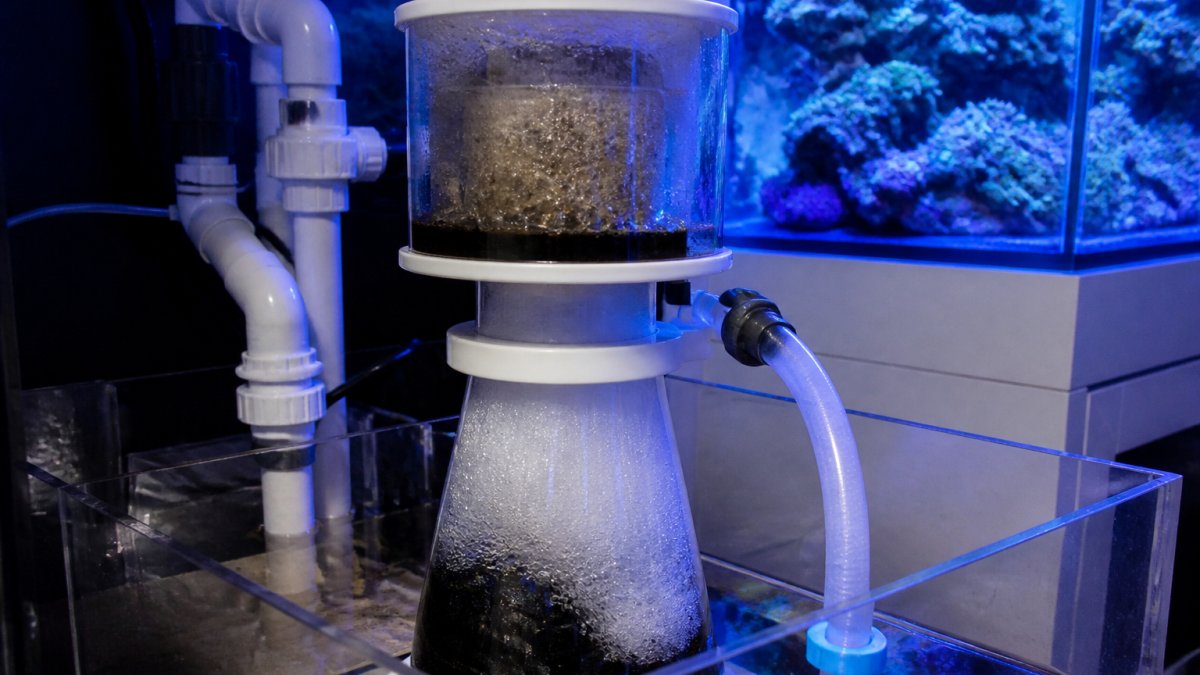
Each unit ships with a water pump, controller, power supply, collection cup, outlet regulating valve, silicone foot pad, external silencer, hose, drainage valve, and diversion box.
AD-C7PLUS: 200-500 Gallon Reef Systems
The AD-C7PLUS is priced at $849.99 and built for large reef aquariums.
For a heavily stocked 200-gallon system, this is the pick.
AD-N230PLUS and AD-N170PLUS: Mid-Size Reef Tanks
Both mid-size models sell for $599.99 and suit established marine tanks. The AD-N230PLUS handles heavy bioloads up to 170 gallons.
The AD-N170PLUS covers heavy bioloads to 100 gallons.
AD-N130 PLUS and AD-N100PLUS: Nano and Starter Reefs
Both entry models cost $279.99. The AD-N130 PLUS is sized for heavy bioloads to 70 gallons.
The AD-N100PLUS suits nano reefs and starter saltwater aquariums with heavy bioloads to 35 gallons.
How to Tune a Protein Skimmer for Consistent Foam
Tuning a protein skimmer is a mechanical process, not a guessing game. Three variables control foam production: the water level inside the reaction chamber, the air the pump draws, and the rate water exits through the outlet valve. Change one at a time and give each change several hours to stabilize.
Protein Skimmer 200-500 Gal Ocean Coral Reef Fish Saltwater Aquarium Pump →
Set the Water Level First
Every skimmer has a target operating depth, listed per unit. If the chamber is deeper than the target, build a stand from egg crate or acrylic so the pump sits at the right height. If shallower, raise the sump water level or choose a different model. Water level is the foundation; air and outlet adjustments do nothing useful if the depth is wrong.
Adjust Air and Outlet in Sequence
Once the water level is correct, open the air intake fully. A needle brush pump pulls air through the venturi inlet, and the silencer should be attached and clear.
Aim for dark, dry skimmate: a thick, brown-black paste that collects slowly. Pale, watery foam means the foam head is too high or the air-to-water ratio is off. If the cup fills in a day with clear liquid, lower the internal water level by opening the outlet valve slightly.
Break-In: What Is Normal and What Is Not
Every new skimmer goes through a one-to-three-week break-in period. During this window, three things commonly happen:
- Overflowing: The cup fills rapidly with wet foam, usually from manufacturing oils or residual compounds on the acrylic and pump parts. Run the skimmer with the cup drain open and let it overflow into the sump until the foam settles. Do not add chemicals to speed this up.
- No foam at all: The bubble column may be visible but not rising. This is normal in the first few days. Confirm the water level is in range, the air intake is open, and the pump is not clogged. If all three check out, wait.
- Microbubbles in the display: Fine bubbles escaping the skimmer outlet and traveling to the return pump. This is common during break-in and usually resolves as the skimmer builds a slime layer. If it persists, check that the outlet is not restricted and that the skimmer is not oversized for the actual bioload, an oversized skimmer can struggle to form a stable foam head and may pass bubbles instead.
A Simple Tuning Checklist
- Confirm the sump water depth matches the model's target range
- Open the air intake fully and verify the silencer is clear
- Run 24 hours before touching the outlet valve
Once the skimmer holds a steady foam head for several days without adjustment, it is tuned. From there, the only routine change is cleaning, a dirty neck or clogged air intake will throw off the setting you just dialed in.
Protein Skimmer Maintenance Tips and Break-In Guidance
Protein skimmer maintenance tips come down to one habit: clean the parts that collect waste, on a schedule.
Rinse the collection cup whenever it fills, and wipe the neck where foam collects. A dirty neck changes foam behavior and reduces efficiency.
- Clean the collection cup weekly, or when it reaches half full
- Rinse the pump rotor and chamber on a regular schedule
- Check the air intake for salt creep and clear any blockage
The break-in period is real, and patience pays off. A skimmer that seems weak in week one often produces steady skimmate by week three.
Protein Skimmer Types: Air-Driven, Venturi, and Recirculating
Protein skimmer types fall into three main families. Air-driven skimmers use an external air pump and work well in nano tanks.
Recirculating skimmers run a dedicated pump that recycles water inside the reaction chamber, giving more contact time between bubbles and water.
Our models use a needle brush pump in a venturi-style design, which balances air intake, water flow, and noise level for the tank sizes listed above.
When a Reef Tank Does Not Need a Skimmer
Not every reef tank needs a skimmer.
If your tank holds a few soft corals, one or two small fish, and you change water consistently, a skimmer may be optional.
Every reef keeper eventually hits the same wall: nutrients creep up, algae takes hold, and water changes stop keeping pace.
Get started with AquaDreamUSA and match your reef tank to a skimmer built for its actual water volume.
Frequently Asked Questions
Do I really need a protein skimmer for my reef tank?
Most reef tanks benefit from a protein skimmer because it removes organic waste before it breaks down into ammonia and nitrite. That said, a lightly stocked tank with frequent water changes can run without one, especially if you rely on other nutrient export methods.
How do I choose the right size protein skimmer for my aquarium?
Start with your total water volume, then factor in bioload. A heavily stocked 100-gallon reef needs a skimmer rated for at least 100 gallons at heavy bioload, while a lightly stocked tank of the same size can use a smaller unit. Check the recommended tank sizes on each model, such as the AD-N170PLUS rated for 100 gallons heavy and 210 gallons light bioload, and confirm sump dimensions before buying.
What is the difference between internal and external protein skimmers?
Internal, or in-sump, skimmers sit inside the sump and rely on a stable water level for consistent foam production. External skimmers sit outside the sump and use a feed pump to draw water in, which keeps heat and clutter out of the sump but requires more plumbing and floor space. For most home reef tanks, an in-sump skimmer is simpler to install and tune.
How often should I clean my protein skimmer?
Clean the collection cup every three to seven days, or whenever it is about half full. Wipe the neck and reaction chamber every two to four weeks to prevent sediment from building up on the needle brush pump, which can increase wear. A full pump cleaning every two to three months keeps air intake and bubble generation at peak performance.
Can a protein skimmer be too powerful for a reef tank?
Yes. An oversized skimmer can strip too much from the water, including trace elements that corals and other filter feeders use. It may also produce unstable foam because the unit never reaches a consistent organic load. Match the skimmer's rated capacity to your actual bioload, not just the tank's gallon rating, to avoid over-skimming.