
 Acuarios y suministros

 Acuarios y suministros para arrecifes de coral

 Jardín, hidroponía y paisajismo

 Estanques, fuentes y cascadas

 Filtro de tambor para estanque

 Comunidad

 Centro de ayuda

7 Steps to Clean Aquarium Filter Media Without Killing Bacteria
Last Updated: October 30, 2026
Quick Summary
To clean aquarium filter media without killing bacteria, rinse it gently in old tank water removed during a water change, never under tap water. Squeeze sponges lightly instead of scrubbing, swish biological media once, and clean only half the biological media at a time so the colony survives.
- Beneficial bacteria mostly live in the filter, not the water, so gentle rinsing protects your cycle.
- Rinse media in old tank water, since tap water chlorine and chloramine kill filter bacteria.
- Squeeze sponges lightly and never wring, scrub, boil, bleach, or bake filter media.
- Rinse mechanical media every 2 to 4 weeks and biological media every 2 to 3 months at most.
- After over-cleaning, change 25 to 50 percent of the water and test ammonia and nitrite daily for a week.
Table of Contents
- Why Beneficial Bacteria Live in Your Filter Media
- What You'll Need Before You Clean Aquarium Filter Media
- How to Rinse Aquarium Filter Media in Tank Water
- Why Tap Water, Chlorine, and Soap Can Wreck Your Cycle
- How Often to Clean Aquarium Filter Based on Flow and Tank Load
- Cleaning a Filter Without a Water Change: Filter-Specific Steps
- What to Do After Accidental Over-Cleaning
- Choosing Replacement Media That Keeps Your Cycle Stable
- Frequently Asked Questions
Why Beneficial Bacteria Live in Your Filter Media
Beneficial bacteria are the invisible engine of your tank, and most live in your filter, not the water. These microbes colonize every surface inside the filter, where oxygen and food flow past constantly.
The nitrogen cycle depends on two groups of bacteria. One turns ammonia into nitrite, and the other turns nitrite into nitrate. Ammonia and nitrite are toxic to fish even at low levels.
Filter media is the surface area those microbes colonize. When you clean, you are not removing dirt alone. You are handling a living colony.
That is the core tension of filter maintenance: clean too little and flow chokes, clean too hard and you wipe out the bacteria doing the work.
What You'll Need Before You Clean Aquarium Filter Media
Gather your tools before you touch the filter, so the media spends as little time out of the water as possible.
You will need:
- A clean bucket reserved for aquarium use only
- A siphon or gravel vacuum
- A soft brush for hard media
- Dechlorinated water on hand for emergencies
- A towel and a dedicated workspace
- Test kits for ammonia, nitrite, and nitrate
Never use a bucket that has held household cleaners or soap. Residue kills bacteria fast. Keep one bucket for tank water and nothing else.
The key rule: everything you rinse with should come from the tank or be dechlorinated first. Tap water contains chlorine or chloramine, which is designed to kill microbes, including the ones you want to keep.
Plan to work during a water change when possible. You are already removing old aquarium water, so you have the perfect rinse supply ready.
How to Rinse Aquarium Filter Media in Tank Water
Rinsing aquarium filter media in removed tank water is the safest method because the water matches your tank's chemistry and carries no chlorine. Follow these steps to clean without stripping the colony.
- Unplug the filter before you open anything.
- Remove the media and place it in your bucket.
- Pour in old tank water from your water change, just enough to cover the media.
- Swish the media gently to loosen debris.
- Squeeze sponges lightly, never wring them out.
- Return the media to the filter promptly.
- Top off the tank with dechlorinated water.
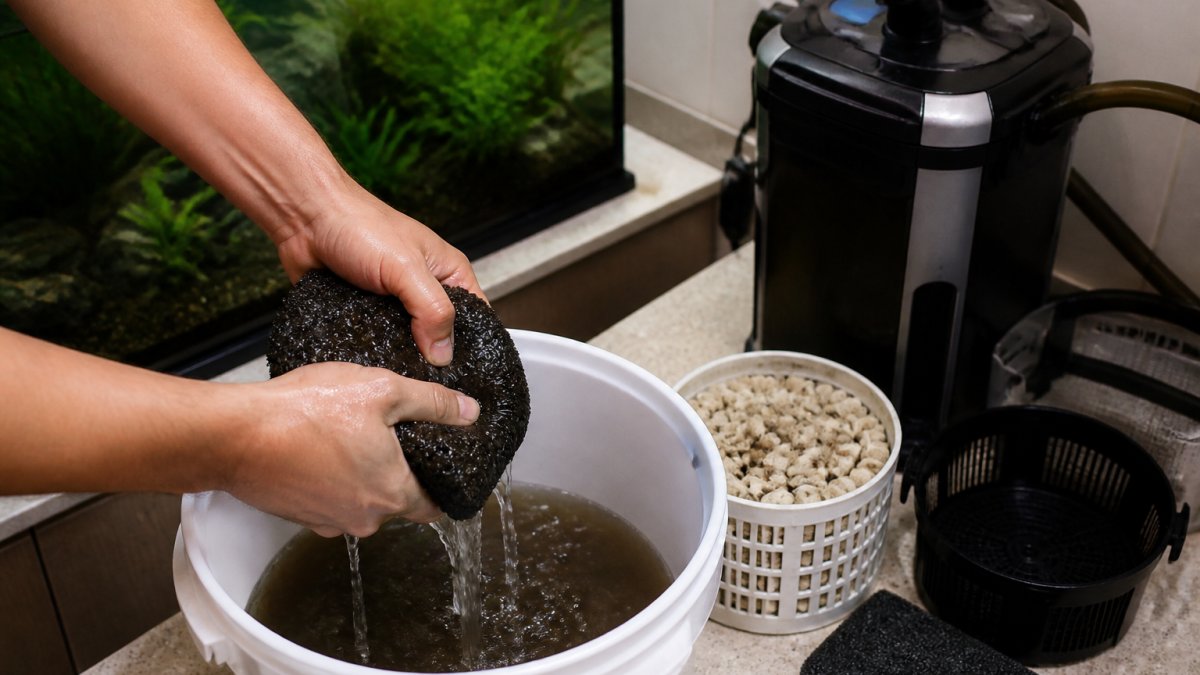
The goal is to remove loose waste, not to make the media spotless. A little brown staining on a sponge is normal and harmless. Stop rinsing once the water in your bucket stops turning dark. The 5 to 10 minutes media spends out of the filter is fine. Hours are not.
Squeeze, Don't Scrub: Handling Sponge and Mechanical Media
Sponge and mechanical media trap physical debris, and they need the gentlest touch of all. Squeeze them in tank water until the worst of the sludge releases. Do not scrub a sponge against the bucket wall or run it under a tap.
Mechanical filtration catches particles before they reach the biological media. A sponge filter sponge holds bacteria as well as dirt, so treat it like a living thing. If you are shopping for one, you can view aquarium sponge filters for fish tanks to see the media type described here.
A common mistake is replacing a sponge the moment it looks dirty. Replacing throws away the colony. Rinse instead, and only replace when the sponge crumbles or loses its shape.
Cleaning Biological Filter Media Without Stripping the Colony
Biological media needs the lightest cleaning of all. Ceramic rings, bio balls, and porous media hold bacteria deep inside their pores, where debris rarely reaches. A gentle swish in old tank water is usually enough.
- Rinse bio balls in a mesh bag rather than loose, so none escape down the drain.
- Swish ceramic rings once, then stop.
- Never boil, bleach, or bake biological media.
- Clean only half the biological media at a time.
For porous ceramic, our Ceramic Media for Fish Tank 5.5 LBS provides a porous surface area that supports beneficial microorganisms. Staggering the cleaning protects the cycle. When one batch is out, the other keeps processing ammonia.

Why Tap Water, Chlorine, and Soap Can Wreck Your Cycle
Tap water and soap can crash your cycle because both are designed to kill microorganisms. Chlorine and chloramine disinfect municipal water supplies, and they do not distinguish between harmful germs and your filter bacteria.
The EPA guidance on drinking water disinfectants explains why chlorine and chloramine are added to public water: to control microbes. That same property makes untreated tap water a risk for filter media.
Watch out: rinsing media under a hot tap is the single most common way hobbyists crash a cycle. The chlorine kills bacteria, and a temperature swing shocks the rest.
One widely shared claim says rinsing sponge filters in tap water does little harm because most bacteria live in the substrate. That claim is unverified and we would not build a routine on it.
How Often to Clean Aquarium Filter Based on Flow and Tank Load
Clean your filter when flow drops or debris builds, not on a fixed calendar. Most tanks need mechanical media rinsed every 2 to 4 weeks and biological media cleaned far less often.
Cleaning frequency depends on your tank, not a schedule on a box:
Ceramic Media for Fish Tank 5.5 LBS – High-Performance Porous Aquarium Filter →
- Heavily stocked tanks: rinse mechanical media every 2 weeks.
- Lightly stocked tanks: every 3 to 4 weeks is fine.
- Reef and saltwater setups: watch flow closely and clean mechanical media as it clogs.
- Biological media: clean every 2 to 3 months at most, and only when flow suffers.
The best signal is water flow. If the filter return weakens, media is clogged and the pump is working harder. Check flow weekly by watching the output.
Test your water after cleaning too. A quick ammonia and nitrite check the next day tells you the colony handled the disturbance. If either reads above zero, do a partial water change and hold off on the next cleaning.
Cleaning a Filter Without a Water Change: Filter-Specific Steps
You can clean a filter between water changes if you prepare rinse water first.
Sponge filters. Lift the sponge off the air lift, squeeze it in the bucket until the heaviest sludge releases, and return it.
Hang-on-back filters. Unplug the unit, lift the intake tube, and remove the cartridge or sponge. Rinse mechanical media first, then biological media last and gentlest.
Canister filters. Open the canister over a towel, lift trays in order, and rinse from top to bottom.
Internal and sump filters. For internal filters, remove the media basket, rinse mechanical foam first, and return biological media with minimal handling.
Flow direction matters. Water hits mechanical media first, then biological media. Clean in that same order so you never push debris into the biological chamber.
What to Do After Accidental Over-Cleaning
If you over-cleaned and the tank looks cloudy or fish gasp at the surface, act fast but do not tear the filter apart again.
Step 1: Test immediately. Check ammonia and nitrite with a liquid test kit.
Step 2: Do a partial water change. Change 25 to 50 percent with dechlorinated water that matches tank temperature.
Step 3: Support the colony. Add a bacterial starter if you keep one on hand. Cut feeding for a day or two to reduce waste.
Step 4: Recheck daily for a week. Test ammonia and nitrite each morning. The cycle is recovering when both read zero for two consecutive days.
Do not panic-clean again. The surviving bacteria will multiply and repopulate the media, usually within days to a couple of weeks.
The Smithsonian's guide to aquarium water quality notes that ammonia and nitrite spikes are the main risk after any disruption to biological filtration, which is exactly why monitoring matters.
Choosing Replacement Media That Keeps Your Cycle Stable
Replacement media should preserve your colony, not restart it. The best approach is staggered replacement: swap one piece of media at a time and let the rest keep processing waste.
Never replace all media at once. That is the fastest way to lose your cycle. For options that protect the cycle, browse our filter media supplies.
For hobbyists looking for porous biological media, our Aqua Dream Ceramic Pillar Bio Filter Media is one option. Our ceramic media runs $28.99, and the ceramic pillar bio filter media is $39.99. Both are listed for freshwater, saltwater, and coral reef aquariums.

| Situation | Action | Why It Protects Bacteria |
|---|---|---|
| Sponge looks dirty | Rinse in tank water | Keeps colony on the sponge |
| Flow slows down | Clean mechanical media first | Restores flow without touching bio media |
| Media crumbles | Replace that piece only | Staggered swap keeps the cycle |
| Ammonia spikes after cleaning | Partial water change and test daily | Supports the recovering colony |
The rule we would give any hobbyist: clean gently, clean in tank water, and never clean everything at once. Your bacteria will reward you with stable water.
Frequently Asked Questions
Should you rinse filter media in tap water or aquarium water?
Rinse it in aquarium water pulled out during a water change. Tap water contains chlorine or chloramine, which kills the nitrifying bacteria that process ammonia and nitrite. Fill a bucket with tank water, squeeze or stir the media in it, and discard the dirty water. If you must use tap water in an emergency, treat it with a dechlorinator first, and never rinse all your bio media at once.
How often should you clean aquarium filter media?
Clean mechanical media like sponges every two to four weeks, or whenever flow drops noticeably. Rinse biological media only when it looks clogged, often every one to three months. Heavily stocked tanks and tanks with messy eaters need more frequent cleaning than lightly stocked planted tanks. Watch your filter's output: a steady decline in flow is the clearest signal that media needs attention.
Can you clean all aquarium filter media at the same time?
No. Cleaning every media stage in one session removes too much of the bacterial colony and can trigger a mini-cycle, where ammonia and nitrite spike. Stagger the work: clean sponges one week, rinse bio media the next. Never replace all filter cartridges together either. Keep old media running alongside new media for a few weeks so bacteria can colonize the replacement.
What should you do if you accidentally wash filter media in tap water?
Don't panic. Most of the colony lives deeper inside the media and in the substrate, so a quick rinse rarely wipes it out. Add a dechlorinator to the tank, test ammonia and nitrite daily for the next week, and hold off on feeding heavily. If you see ammonia or nitrite rise, do a partial water change and dose a bacteria starter. Avoid cleaning any other media until parameters return to zero.
Cleaning filter media is a skill, and getting it right protects everything in your tank. If you are ready to build a filtration setup that holds a strong colony, AquaDreamUSA can help. We offer porous ceramic media, sponge filters, and bio balls designed for freshwater, saltwater, and reef systems. Our team has supplied aquatic gear since 1999, and we stock the media and filtration supplies that keep cycles stable. Get started with AquaDreamUSA and shop reliable filter media today.