

 Aquariums & Supplies

 Coral Reef Aquariums & Supplies

 Garden & Hydroponics & Landscape

 Ponds & Fountains & Waterfalls

 Drum Pond Filter

 Community

 Help Center

9 Quiet Pond Aerator Pumps Compared for Large Ponds
Quick Summary
A quiet pond aerator pump for large ponds should be sized to pond volume first, then placed on a rubber pad above the waterline with a short air line. Undersized pumps run harder and can end up louder, so match capacity to gallons before comparing noise.
- Estimate gallons by multiplying length, width and average depth in feet, then by 7.5.
- The 14W 4-outlet air pump is listed for 90 to 400 gallons at $89.99.
- The 12W 4-outlet air pump is listed for 60 to 240 gallons at $76.99.
- Place the pump on a dense pad, not soft foam, to limit vibration transfer into surfaces.
- Keep enclosures ventilated, since a sealed air pump overheats and can get louder.
Table of Contents
- Why Large Ponds Need Aeration and Why Noise Matters
- Pond Aerator Pump Sizing for Large Ponds
- Quiet Pond Aerator Pump Noise Reduction Techniques
- AquaDreamUSA Air Pump Models Compared
- How Many Hours a Day Should You Aerate a Pond
- Quiet Pond Aerator Pump for Large Ponds Cost and Running Expenses
- Choosing Your Large-Pond Aeration Setup at AquaDreamUSA
- Frequently Asked Questions
9 Quiet Pond Aerator Pumps Compared for Large Ponds
Last Updated: November 7, 2026
Why Large Ponds Need Aeration and Why Noise Matters
Large ponds lose oxygen fast, especially in summer when warm water holds less of it (Dissolved Oxygen and Water).
Aeration supplies oxygen for fish and beneficial bacteria, circulates water so warm layers do not stagnate, and reduces conditions that favor algae blooms.
A general approach is to size the airflow first, then choose the model that meets it.
Pond Aerator Pump Sizing for Large Ponds
Sizing starts with pond volume, not surface area alone. A deep pond needs more air than a shallow pond of the same footprint, because bottom water sits under more pressure and the diffuser must push air through a longer column.
A simple sizing process is:
- Measure length, width and average depth in feet.
- Multiply those figures to estimate gallons (length × width × average depth × 7.5).
- Match that volume to a pump rated for the same range, then add headroom for summer heat and fish load.
The listings are rated by capacity: the 4-outlet 14W model for 90 to 400 gallons, the 12W model for 60 to 240 gallons.
Matching Airflow to Pond Depth and Shape
Depth changes the math more than most buyers expect.
Shape matters too. Irregular ponds with coves or shelves can develop dead zones where water barely moves.
Seasonal conditions also shift the requirement. Warm water holds less oxygen, so a setup that is adequate in spring may need more output during a July heat wave (Dissolved Oxygen and Water).
Quiet Pond Aerator Pump Noise Reduction Techniques
Noise levels are not standardized across pond aerator brands, so it helps to understand where the noise comes from, control each path, and measure your own installation under consistent conditions.
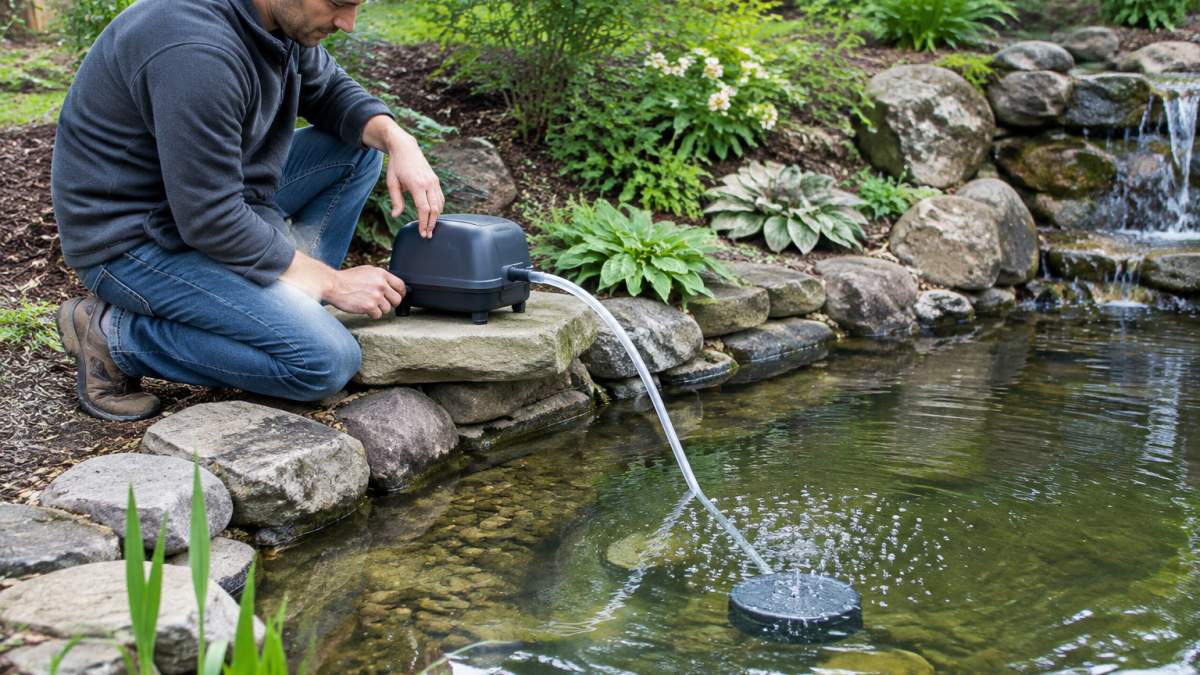
Noise leaves an air pump through three paths:
- Airborne motor noise radiating from the housing.
- Structure-borne vibration traveling into whatever the pump sits on.
- Airline and diffuser noise from turbulent airflow and bubbling at the surface.
Each path needs a different fix, and treating only one usually leaves the installation louder than expected.
Isolate Vibration First
The mounting surface is the biggest variable in real installations. A pump with anti-vibration feet still transmits energy into a wooden deck, metal shelf, or hollow rail, and those surfaces act as sounding boards.
Watch out: stacking soft foam under a pump can let it sag or shift, which misaligns the motor and can increase noise over time. Use a firm, dense pad rather than soft packing material.
Place the Pump Deliberately
Distance and line of sight both matter. Sound drops with distance, and a hard patio, retaining wall, or fence reflects it back toward the house. Moving a pump from a deck rail to a stone pad ten to fifteen feet farther from a bedroom window often does more than any accessory. Keep the pump above the waterline in a dry, shaded spot, since the listed air pumps are not waterproof.
Control the Air Path
Loose or long airline vibrates and can rattle against edges. Keep runs as short as the layout allows, secure the tubing with clips, and avoid sharp bends that increase back pressure. A clogged inlet filter cotton forces the motor to work harder, which raises both noise and heat, so clean the bottom inlet filter on the schedule in the product instructions.
Enclosures: Ventilation Is Not Optional
A ventilated enclosure can cut airborne motor noise noticeably, but it must move air. An air pump in a sealed box overheats, and heat shortens motor life and can raise noise as the unit works harder.
- Provide intake and exhaust openings sized so the enclosure does not restrict airflow.
- Line the interior with a sound-absorbing material that will not shed fibers into the intake.
- Leave clearance around the pump body and never rest the enclosure against the pump.
Watch out: enclosing a pump that is already running hot makes the problem worse. If the housing is too warm to hold your hand on comfortably, improve ventilation before adding sound treatment.
Measure Your Own Setup
You can build comparable noise data without lab equipment. Use a smartphone sound-level app at a consistent distance (for example, three feet from the pump and at the nearest window), and record readings at the same time of day with the same background conditions. Log the number before and after each change: rubber pad, relocation, shorter airline, enclosure.
What the Bubbling Itself Contributes
Diffuser noise is often underestimated. Fine-bubble diffusers are generally quieter at the surface than coarse bubbles, and placing the diffuser away from the shoreline nearest the house reduces perceived sound even when airflow is unchanged. If surface sound is the complaint, adjust diffuser placement and airflow before replacing the pump.
AquaDreamUSA Air Pump Models Compared
We currently offer two air pump models suited to smaller and medium pond setups, plus three submersible and external pond pumps for higher-flow circulation. The comparison below uses the figures from our product listings.
| Model | Listed Capacity | Output | Listed Price | Best For |
|---|---|---|---|---|
| 14W 4-Outlet Air Pump | 90-400 gallons | 4 × 6 L/min | $89.99 | Larger air-driven aeration |
| 12W 4-Outlet Air Pump | 60-240 gallons | 4 × 4.5 L/min | $76.99 | Mid-size ponds |
| 4230 GPH Submersible Pump (160W) | Pond circulation | 4,230 GPH / 16,000 L/H | $219.99 | Circulation and filtration feed |
| 5810 GPH Submersible Pump (250W) | Pond circulation | 5,810 GPH / 22,000 L/H | $253.99 | Larger circulation needs |
| 6870 GPH Submersible Pump (400W) | Pond circulation | 6,870 GPH / 26,000 L/H | $330.99 | Largest flow requirements |
Listed Price
Air Pump Specifications and Who Each Suits
14W 4-Outlet Air Pump ($89.99). This is our highest-output air model. It delivers up to 4 × 95 GPH, with air pressure of 0.02-0.026 MPa, and it runs with an integrated air chamber and anti-vibration pads.
12W 4-Outlet Air Pump ($76.99). A lower-output version with up to 4 × 75 GPH and air pressure of 0.018-0.024 MPa. The listing describes it for ponds in the 60 to 240 gallon range.
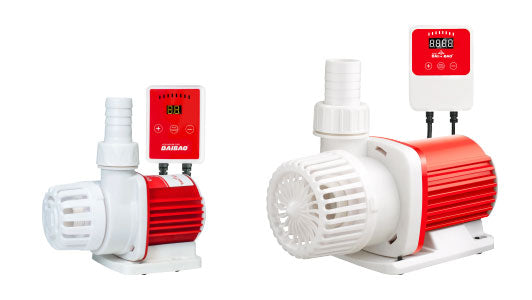
Submersible and external pumps. The three BTC-series pumps are circulation tools rather than air pumps. The listings describe them as amphibious, with an external controller offering 20 speed settings and a pause button, for fishponds, fountains and water-feature circulation. Skip them if you need only bubble-based aeration, since they solve a different problem.
How Many Hours a Day Should You Aerate a Pond
Most pond keepers run aeration continuously during warm months, particularly where fish density is high or water temperatures climb above the mid-70s°F. In cooler seasons, many owners reduce run time but rarely turn the pump off entirely in ponds with fish.
A practical schedule looks like this:
- Summer: run around the clock, checking oxygen behavior on hot, still nights.
- Shoulder seasons: run continuously if the pond is stocked, or at reduced intervals if it is lightly populated.
- Winter: keep a small opening in the ice if needed, following local guidance for your climate.
Watch the fish. Gasping at the surface, crowding near outflows or lethargy are signs the pond needs more oxygen, not less.
Quiet Pond Aerator Pump for Large Ponds Cost and Running Expenses
Purchase price tells you almost nothing about what an aerator costs to own. Electricity, replacement parts, and service life usually decide whether a cheaper pump is actually cheaper. The figures below use listed prices and wattages from our product pages and a placeholder electricity rate you replace with your own; check your utility bill, since rates vary widely across the United States.
Worked Electricity Example
The formula is straightforward: watts × hours run × days ÷ 1,000 = kilowatt-hours, then multiply by your rate.
- 14W air pump, continuous for a year: 14 × 24 × 365 ÷ 1,000 = about 123 kWh. At $0.17 per kWh, that is roughly $21 per year.
- 12W air pump, continuous for a year: about 105 kWh, or roughly $18 per year at the same rate.
- 160W circulation pump, continuous for a year: about 1,402 kWh, or roughly $238 per year.
The pattern is the point: the air pumps cost a few dollars a month to run, while the high-wattage circulation pumps can cost more in electricity over a year than their listed purchase price. If you run a circulation pump only during warm months, scale the hours accordingly.
Purchase Price Versus Five-Year Cost
A simple total-cost-of-ownership view adds purchase price, electricity, and expected replacement parts over a service life. Using the 14W air pump at $89.99 and the $21 annual electricity estimate:
- Purchase: $89.99
- Five years of electricity: about $105
- Diffuser stones and airline over five years: budget a modest amount, since these wear and are inexpensive relative to the pump
The air pump's five-year electricity cost is modest in comparison to the purchase price. The 400W circulation pump at $330.99, by contrast, carries roughly $596 per year in electricity at the same rate, so its five-year total is dominated by power, not purchase price, the comparison most buyers miss when shopping on sticker price alone.
Replacement Parts and Service Life
Air pumps have few wear items, such as inlet filter cotton and airline, and keeping the inlet clean is generally good practice. Diffusers are the part most likely to need periodic replacement, and airline degrades with sun exposure, so route it out of direct sunlight where possible.
Watch out: buying a pump rated well below your pond volume may not save money over time, since an undersized unit can run harder and hotter.
Where the Money Actually Goes
For a large pond, the honest cost picture is usually a small air pump plus a larger circulation pump, not one device doing everything. The air pump handles aeration at lower running cost; the circulation pump moves water for fountains and filtration and draws more power. Sizing each to its job, and running the circulation pump only when needed, is the most reliable way to control long-term cost.
Choosing Your Large-Pond Aeration Setup at AquaDreamUSA
Start with your pond volume and fish load, then choose the output that covers it with room to spare.
If you want a quieter setup, mount the pump on a rubber pad above the waterline and keep the air line short. If you are unsure which model fits, browse the full collection to compare the specifications side by side:
- Browse our reliable aerators for fish tanks and ponds to see boosted-oxygen options in one place.
- Explore reliable aeration pumps for ponds if quiet, efficient operation is your priority.
- Shop the best quiet aquarium air pumps for lower-noise picks across our range.
For sizing questions specific to your pond, review the listing details before you buy, then choose the model whose capacity range matches your water volume.
Quiet aeration is achievable for large ponds when airflow, mounting and placement are all matched to the job.
Frequently Asked Questions
What are the best aeration pumps for large ponds?
For large ponds, the options in the AquaDreamUSA range include the 14W Quiet Air Pump rated at 4x95 GPH for 90-400 gallon systems, priced at $89.99, and the 12W model at 4x75 GPH for 60-240 gallons, priced at $76.99. Both use anti-vibration rubber feet and an integrated air chamber to isolate mechanical noise. Match the pump's rated gallon range to your pond's actual volume.
How many hours a day should you aerate a pond?
Many pond keepers run aeration for long periods, particularly in warm months. Run time depends on your pond, fish load and climate. Check the water in the early morning for signs of stress, such as fish gasping at the surface, and extend run time if you see them.
How can I make a pond aerator pump quieter?
Keep the pump out of the water and place it on a firm surface with its anti-vibration rubber feet in contact. Run the air line through flexible tubing rather than rigid pipe, and avoid resting the pump directly on a hard wall or deck that can amplify sound. The gas regulation knob offers four airflow adjustments to suit your aquarium or pond.
What is the difference between a pond aerator pump and a water pump?
A pond aerator pump pushes air to a diffuser or air stone at the bottom of the pond, creating rising bubbles that add oxygen and circulate water. A water pump, such as the AquaDreamUSA 4230 GPH submersible pump, moves water itself for fountains, filtration or waterfalls. Air pumps are usually quieter and cheaper to run, while water pumps provide surface movement and flow. Many large ponds use both, an air pump for oxygen and a water pump for circulation.