
 Aquariums & Supplies

 Coral Reef Aquariums & Supplies

 Garden & Hydroponics & Landscape

 Ponds & Fountains & Waterfalls

 Drum Pond Filter

 Community

 Help Center

How to Maintain Stable Aquarium Salinity
Table of Contents
- Understanding Aquarium Salinity and Stable Salinity Targets
- Why Salinity Swings Happen: Evaporation, Leaks, and Salt Creep
- Measuring Salinity with a Refractometer: Calibration and Technique
- Setting Up an Automatic Top-Off System for Saltwater Aquariums
- Managing Salinity Changes During Water Changes
- How to Raise Salinity in a Saltwater Tank Safely
- Weekly Salinity Monitoring and Maintenance Routine
- Troubleshooting: Rising vs. Falling Salinity and What to Do
- Frequently Asked Questions
Last Updated: October 19, 2026
Understanding Aquarium Salinity and Stable Salinity Targets
To maintain stable aquarium salinity is the foundation of a healthy saltwater tank. Salinity measures the concentration of dissolved salts in your water. For reef tanks, the target sits between 1.023 and 1.025 specific gravity (or 32-35 parts per thousand). Fish-only setups can tolerate a slightly wider range of 1.020 to 1.025, but stability matters more than the exact number.
Why does stability matter? Fish and corals evolved in ocean environments where salinity changes slowly over weeks or months, not hours. Rapid swings stress livestock and trigger disease. A tank that holds steady at 1.024 outperforms one that bounces between 1.020 and 1.028.
Salinity ranges for reef tanks versus fish-only setups
Reef tanks demand precision. Corals are sensitive to osmotic stress. A stable 1.024 keeps them healthy. Fish-only tanks give you more flexibility. Many hobbyists run fish-only setups at 1.020 because it's easier to maintain and slightly cheaper to mix. The trade-off: fish at lower salinity may show reduced color and vigor over time.
Here's the practical difference:
- Reef tanks: 1.023-1.025 specific gravity (target 1.024)
- Fish-only tanks: 1.020-1.025 specific gravity (target 1.023)
- Nano tanks: 1.024-1.026 specific gravity (tighter tolerance due to rapid parameter swings in small volumes)
The key is picking a target and holding it, this is how you maintain stable aquarium salinity. At AquaDreamUSA, we recommend choosing your salinity target based on what your livestock prefers, then building your maintenance routine around keeping it stable.
Why Salinity Swings Happen: Evaporation, Leaks, and Salt Creep
Salinity doesn't drift randomly. Three forces drive it: evaporation, leaks, and salt creep.
Evaporation is the biggest culprit. Pure water evaporates from your tank. Salt stays behind. Over two weeks, a 100-gallon tank can lose 5-10 gallons of water to evaporation alone.
Leaks work the opposite direction. A slow drip from a powerhead seal or return line removes both salt and water. Salinity falls.
Salt creep is sneaky. Saltwater splashes on your glass, equipment, and stand. Water evaporates. Salt crystals remain.
Understanding the cause tells you the fix. Evaporation? Top off with fresh water. Leaks? Find and seal them. Salt creep? Wipe surfaces and adjust your top-off routine.
Measuring Salinity with a Refractometer: Calibration and Technique
A refractometer is your most reliable tool for measuring salinity. It reads the way light bends through your sample, which changes based on salt concentration. Digital refractometers are accurate and fast. Analog versions work just as well if you calibrate them properly.
Calibration is non-negotiable. An uncalibrated refractometer can drift 0.003-0.005 over time, enough to throw off your entire maintenance routine. Calibrate before each measurement session, it takes 30 seconds.
Step-by-step calibration process
- Rinse the refractometer with distilled water. Wipe the lens dry with a soft cloth.
- Place a drop of calibration solution (usually provided with the refractometer) on the lens.
- Close the cover plate and hold it up to light. Look through the eyepiece.
- Read the scale. Calibration solution should read 1.000 (or 0 ppt for salinity-only models).
- Adjust the calibration screw (small dial on the side) until the reading matches exactly.
- Rinse again with distilled water before testing your sample.
Most refractometers drift because people skip this step or use old calibration solution. Fresh calibration solution matters. Replace it yearly.
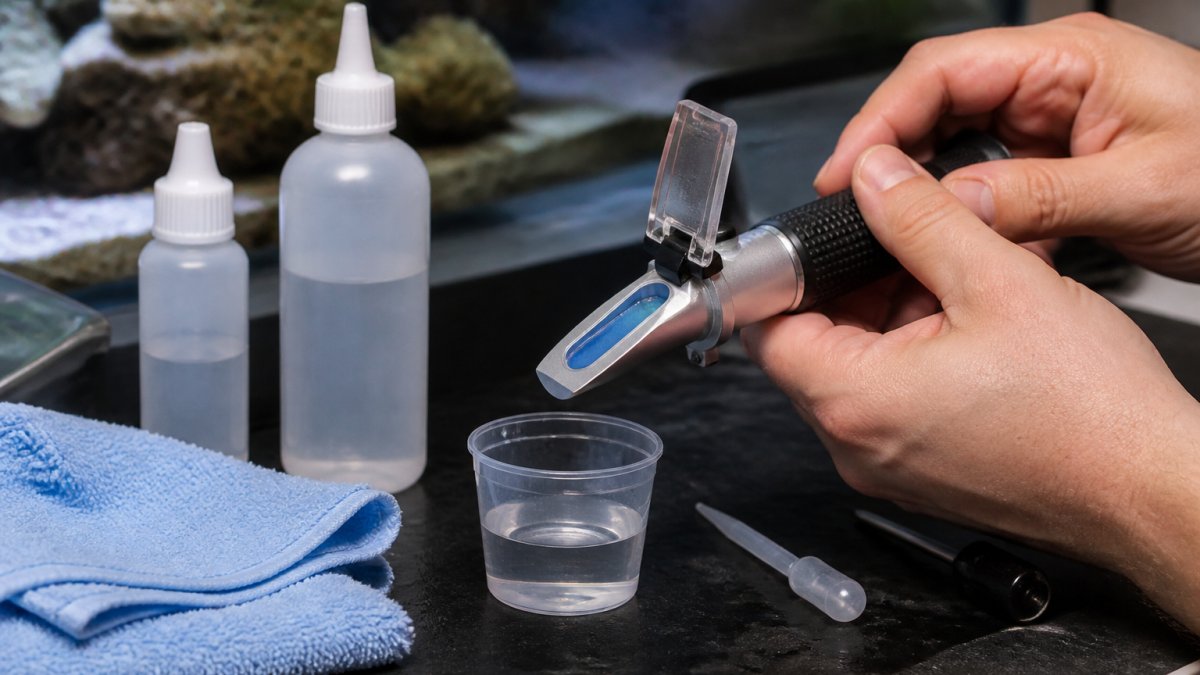
Taking accurate salinity readings
Accuracy depends on technique. Temperature matters. Refractometers are calibrated to 68°F. If your sample is 78°F, the reading can shift 0.001-0.002.
Take your sample from the middle of the tank, not the surface. Surface water can have different salinity due to evaporation and water movement. Use a clean cup or vial.
Place one small drop on the lens. Too much sample causes air bubbles and false readings. Close the cover plate gently.
Record your measurement. Write it down or log it in a spreadsheet. Trends matter more than single readings. If you see a consistent climb or fall, you know something needs adjustment.
Setting Up an Automatic Top-Off System for Saltwater Aquariums
An automatic top-off system (ATO) removes the biggest maintenance burden: daily top-offs. It monitors water level and adds fresh water when the level drops. No thinking. No guessing. No missed days.
ATOs come in two types: float-switch models and optical sensors. Float-switch systems are simpler and cheaper. A mechanical arm floats on the surface. When water drops, the arm triggers a solenoid valve that opens a feed line. Optical sensors use infrared light to detect water level. Both work well if installed correctly.
Sizing an ATO system for your tank volume
Size matters. An ATO that's too small can't keep up with evaporation on hot days. One that's too large can overshoot and add too much water, causing salinity to drop.
A typical saltwater tank loses 2-5% of its volume per week to evaporation. A 100-gallon reef tank evaporates 2-5 gallons per week.
Here's the sizing rule: your ATO reservoir should hold at least 10% of your tank volume. A 100-gallon tank needs a 10-gallon reservoir. This gives you a safety margin.
The feed rate should be slow. Most systems run at 5-20 gallons per hour. Slower is better.
Using RO/DI water in your automatic top-off
Always use RO/DI water (reverse osmosis/deionized water) in your ATO. Never saltwater. Never tap water.
Tap water contains minerals and chlorine. Over weeks, minerals accumulate in your tank and raise alkalinity and calcium unpredictably. Chlorine damages fish gills and kills beneficial bacteria.
RO/DI water is pure. It has no minerals, no chlorine, no dissolved solids. When you top off with RO/DI, you're replacing only the water that evaporated. The salt stays behind. Your salinity stays stable.
Many hobbyists produce their own RO/DI water using a home system. Others buy it from local fish stores or grocery stores (many have RO/DI dispensers). At AquaDreamUSA, we stock high-quality RO/DI systems designed for aquarium use.
Managing Salinity Changes During Water Changes
Water changes are essential for removing waste and replenishing trace elements. But they're also the easiest time to crash your salinity. Get it wrong, and you'll stress your livestock immediately.
The rule is simple: match the salinity of your replacement water to your tank's current salinity. If your tank is at 1.024, your replacement water should be 1.024. Not 1.020. Not 1.026. Exactly 1.024.
Preparing replacement water and matching salinity
Prepare your replacement water at least 24 hours before the water change. Mix salt into RO/DI water using a separate container or barrel. Stir thoroughly. Let it sit overnight.
Measure the salinity of your prepared water with your refractometer. Adjust if needed. If it reads 1.022, add a pinch more salt.
Once your replacement water matches your tank's salinity, you're safe to do the water change. Remove the old water slowly. Add the new water slowly. Sudden changes stress fish and corals.
For a 100-gallon tank doing a 25-gallon water change, expect this process to take 30-45 minutes from start to finish. Patience pays off.
How to Raise Salinity in a Saltwater Tank Safely
If your refractometer shows salinity below target, you need to raise it. The temptation is to add saltwater directly. Don't. That's the fastest way to shock your livestock.
Instead, stop topping off with fresh water. Switch to topping off with saltwater mixed to your target salinity. This raises salinity gradually over days or weeks.
Gradual adjustment schedule based on tank size and error magnitude
The bigger your error, the longer the correction takes. A drop from 1.024 to 1.020 is a 0.004 swing. A 100-gallon tank should take 7-10 days to recover. A 50-gallon tank should take 4-5 days.
Never try to correct salinity in less than 3-5 days. Faster changes stress fish and corals. Slower is always safer.
Here's a practical schedule:
- Small error (0.001-0.002): 3-5 days using saltwater top-offs
- Medium error (0.002-0.004): 5-10 days using saltwater top-offs
- Large error (0.004+): 10-14 days using saltwater top-offs, or a partial water change followed by gradual adjustment
For a large error in a small tank, a partial water change is faster and safer. Remove 25% of the tank water and replace it with water mixed to your target salinity. This shifts the salinity immediately but in a controlled way. Then resume normal top-offs.
Weekly Salinity Monitoring and Maintenance Routine
Consistency beats perfection. A simple weekly routine catches problems before they become crises.
Every Sunday (or pick a day), do this:
- Calibrate your refractometer with fresh calibration solution.
- Take a salinity reading from the middle of your tank.
- Record the reading in a spreadsheet or app.
- Check your ATO reservoir for debris or algae. Top it off if needed.
- Inspect for leaks around powerheads, returns, and seals.
- Wipe salt creep off the glass, stand, and equipment with a damp cloth.
This routine takes 10-15 minutes. Over a month, you'll see trends. Stable readings mean your system is working. A slow climb or fall tells you something needs adjustment.
At AquaDreamUSA, we recommend keeping a simple log. Date, salinity reading, ATO status, notes. After three months, you'll understand your tank's natural rhythm. You'll know how much it evaporates per week and when adjustments are needed.
Troubleshooting: Rising vs. Falling Salinity and What to Do
Salinity problems fall into two categories: rising or falling. The cause determines the fix.
Rising salinity means water is leaving the tank faster than salt. Evaporation is the culprit 95% of the time.
Falling salinity means salt is leaving the tank. A leak is the most common cause. Inspect your entire system for drips.
If you find no leak, you may have diluted the tank accidentally. Did you do a large water change with water that was too fresh?
For a quick troubleshooting flowchart:
- Salinity rising? → Check ATO is running → Increase top-off frequency or ATO rate
- Salinity falling? → Inspect for leaks → Check recent water changes → Add saltwater top-offs
- Salinity stable? → Keep doing what you're doing → Continue weekly monitoring
Maintaining stable aquarium salinity isn't complicated. It's a rhythm: measure weekly, top off with the right water, catch problems early.
AquaDreamUSA has been helping aquarists dial in their water parameters since 1999.
| Salinity Issue | Cause | Solution | Timeline |
|---|---|---|---|
| Rising salinity | Evaporation | Increase ATO rate or manual top-offs | 3-5 days |
| Falling salinity | Leak or dilution | Find leak, use saltwater top-offs | 5-10 days |
| Stable salinity | Normal operation | Continue weekly monitoring | Ongoing |
Frequently Asked Questions
What salinity level should I maintain in a reef tank versus a fish-only saltwater aquarium?
Reef tanks require stable salinity between 1.023 and 1.026 specific gravity (approximately 30-35 ppt). Fish-only saltwater setups tolerate a wider range of 1.020 to 1.025. The tighter range for reefs protects corals and maintains the mineral balance they depend on. Always use a refractometer to verify your salinity reading, and make adjustments gradually to avoid shocking livestock.
How often should I test aquarium salinity?
Test salinity at least once weekly during routine maintenance. If you're dealing with rising or falling salinity, test every 2-3 days until the problem stabilizes. New setups or tanks without an automatic top-off system should be tested more frequently. Record readings in a log to identify trends and catch problems early before they affect corals or fish.
Should I use saltwater or freshwater for aquarium top-offs?
Always use freshwater (RO/DI water) for top-offs. Evaporation removes only water, leaving salt behind, so adding fresh water restores the correct salinity level. Adding premixed saltwater during top-off causes salinity to rise. An automatic top-off system should be plumbed to dispense only RO/DI water to prevent accidental oversalting.
How quickly can I safely adjust aquarium salinity if it's too high or too low?
Adjust salinity gradually: aim for no more than 0.002 specific gravity change per day for established tanks. For a 75-gallon reef tank, this typically means a 2-3 week correction period for significant errors. Rapid swings stress or kill corals and fish. Use partial water changes with properly prepared replacement water, combined with adjusted top-off routines, to move salinity safely toward target levels.