

 Aquariums & Supplies

 Coral Reef Aquariums & Supplies

 Garden & Hydroponics & Landscape

 Ponds & Fountains & Waterfalls

 Drum Pond Filter

 Community

 Help Center

How to Choose an Aquarium Heater for a Small Shrimp Tank in 2026
Last Updated: November 1, 2026
Quick Summary
An aquarium heater for a small shrimp tank should hold a steady temperature without large swings, which matters more than any single setting. Choose a small unit rated for your tank's volume, since an oversized heater can overshoot quickly. Verify it with a separate thermometer placed away from the heater before adding shrimp.
- Shrimp are sensitive to sudden temperature shifts, so steady heat matters most.
- Check the manufacturer's volume guidance instead of relying on a rule of thumb.
- Choose a preset heater for simplicity or an adjustable one for more control.
- Always keep the water level above the heater's minimum mark.
- Place the heater near filter outflow so heat spreads evenly.
Table of Contents
- Why a Small Shrimp Tank Needs a Dependable Heater
- Shrimp Tank Temperature Range: What Your Shrimp Actually Need
- Choosing the Right Heater Size for a 5 Gallon Tank
- Small Aquarium Heater with Thermostat: Preset vs Adjustable
- How to Heat a Nano Aquarium Safely
- Placement and Monitoring to Prevent Temperature Swings
- Common Heater Mistakes in Small Shrimp Tanks
- Choosing Your Heater and Checking Current Prices at AquaDreamUSA
- Frequently Asked Questions
Why a Small Shrimp Tank Needs a Dependable Heater
Shrimp are small, and small tanks change temperature fast. A nano shrimp tank can drift several degrees in a single afternoon when a room cools at night or sits near a sunny window. An aquarium heater is the piece of equipment that keeps the water steady, and choosing the right one is the difference between a colony that breeds and one that slowly declines. Stable thermal conditions also provide the necessary foundation for the delicate plants for nano tanks that help maintain the water quality your shrimp require.
Most shrimp keepers focus on the substrate, the water parameters and the plants. The heater often gets treated as an afterthought. That is a mistake. Shrimp are sensitive to sudden shifts, and a heater that cycles unevenly or overheats a small volume can stress the whole colony.
This guide walks through how to choose an aquarium heater for a small shrimp tank in 2026. It covers target temperatures, heater sizing, thermostat options, safe setup, placement and common mistakes.
Shrimp Tank Temperature Range: What Your Shrimp Actually Need
Most popular freshwater shrimp do well in a stable range that sits a little above typical room temperature. The exact number depends on the species, so check the requirements for the shrimp you keep. The more important goal is consistency. A tank that holds steady within a narrow band is safer than one that swings between warm and cool.
Aim for a heater setting that keeps the water in the species' range without large daily swings. Keep the thermometer in the tank, away from the heater, so you read the true water temperature.
Choosing the Right Heater Size for a 5 Gallon Tank
A 5 gallon tank is small enough that heater wattage matters. A heater that is too powerful can overshoot the target temperature quickly, while one that is too weak may struggle in a cool room. Choose a small heater rated for tanks in this volume range, then confirm the rating against the tank size printed on the packaging.
Check the manufacturer's volume guidance rather than relying on a rule of thumb. Note whether the heater is sized for the actual water volume or for the tank's rated capacity, since the two can differ.
Small Aquarium Heater with Thermostat: Preset vs Adjustable
A preset heater is set at the factory to one temperature. It is simple, but it limits you to that setting. An adjustable heater lets you choose the target temperature, which is useful if you keep more than one species or want to fine-tune the setup.
Either type works for a small shrimp tank if it holds temperature reliably. Adjustable models give more control. Presets suit keepers who want a set-and-forget option. In both cases, verify the thermostat behavior with a separate thermometer over several days before trusting it.
How to Heat a Nano Aquarium Safely
Safety starts with never running the heater out of water. Submerge it fully according to the instructions, and unplug it before any water change or maintenance. Use a heater guard or place the unit where a shrimp cannot become trapped against the hot surface.
Watch out: a heater that stays on while the water level drops can overheat the remaining water within minutes. Keep the water level above the heater's minimum mark every time you top off or perform maintenance.
Plug the heater into a grounded outlet, ideally on a surge protector or a GFCI-protected circuit. Avoid running cords where water can splash onto them.
Placement and Monitoring to Prevent Temperature Swings
Place the heater in a spot with good water flow, usually near the filter outflow, so heat spreads evenly. Do not bury it in gravel or hide it behind decorations where it can heat one area far more than the rest. Position the heater low enough that it stays submerged even as the water level drops.
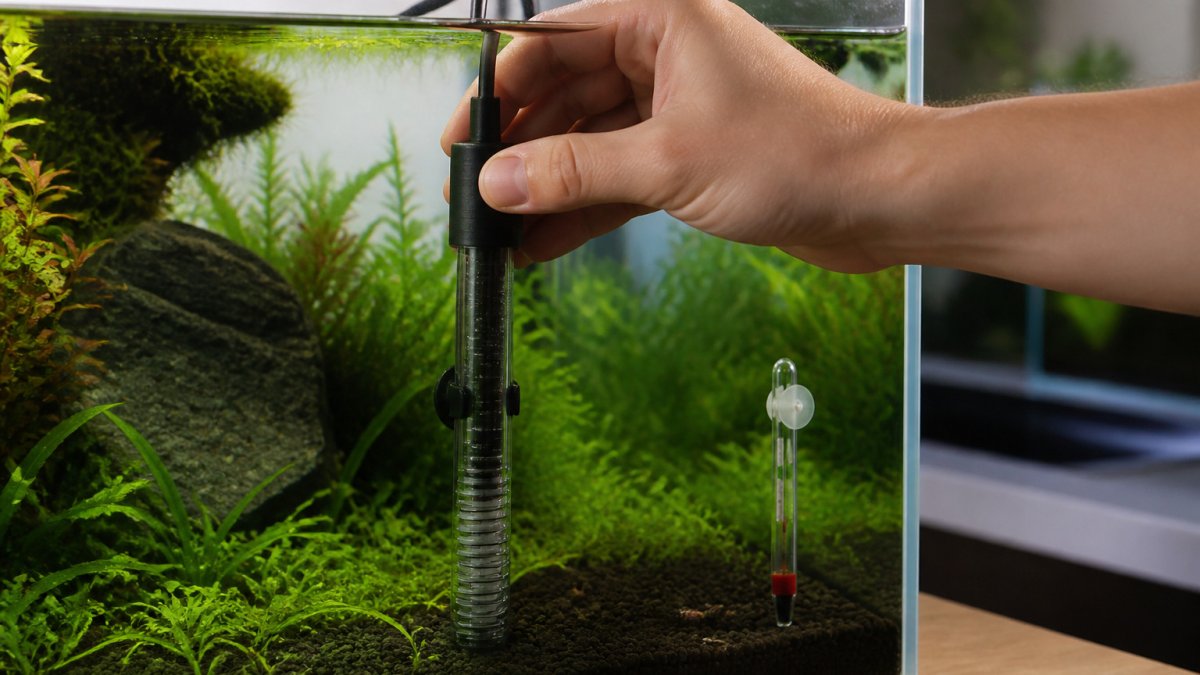
Monitoring is what catches problems early. Place a reliable thermometer in the tank, away from the heater. Check it daily during the first weeks, then at regular intervals. Keep the tank out of direct sunlight and away from drafts from windows, doors and air vents.
Common Heater Mistakes in Small Shrimp Tanks
The most frequent mistake is trusting a heater without checking it. A thermostat can fail or drift, so verify the temperature with your own thermometer.
Another common error is oversizing the heater. A powerful unit in a small volume causes sharp temperature spikes. Some keepers also forget to unplug the heater during water changes, which risks damaging the element.
Finally, many keepers mount the heater in a corner with no circulation. Heat then pools in one spot while the rest of the tank stays cool.
The article points out a few recurring errors that catch small shrimp tank keepers out.
| Mistake | Cause | Fix |
|---|---|---|
| Trusting the heater unchecked | Thermostat can fail or drift | Verify with your own thermometer |
| Oversized heater | Powerful unit in small volume | Choose a wattage matched to tank volume |
| Heater left plugged in during water changes | Forgotten unplugging | Unplug before any water change |
| Heater in a corner with no circulation | Heat pools in one spot | Place near filter outflow for flow |
Choosing Your Heater and Checking Current Prices at AquaDreamUSA
Pricing depends on quantity, dates, and delivery. You can also find a compact kit that already includes filtration for a small shrimp tank. Check the AquaDreamUSA website for current prices or a quote before you order.
When you are ready to shop, browse aquarium heaters and related equipment at AquaDreamUSA. Choose the wattage that matches your tank volume, decide between preset and adjustable, and pair the heater with a reliable thermometer. Then confirm the temperature for a few days before adding shrimp.
Frequently Asked Questions
Do small shrimp tanks need a heater?
Many shrimp tanks, especially those under 10 gallons, benefit from a heater because room temperatures often swing with the day and night cycle. Shrimp are sensitive to sudden changes, and stable water helps them molt and breed successfully. If your room stays consistently within the range your shrimp species tolerates, you may not need one, but most keepers find a heater with a thermostat gives more reliable results and reduces stress on the colony.
What size heater do I need for a 5 gallon shrimp tank?
A 5 gallon tank needs a heater sized for the tank volume and the difference between room temperature and your target temperature. Choose a heater labeled for 5 gallons or smaller rather than an oversized unit, since an oversized heater makes it harder to hold a stable temperature. Check the manufacturer's rating and confirm it matches your tank volume before buying.
Can an aquarium heater be too powerful for a small tank?
Yes. A heater that is too powerful for a small tank can overshoot the set temperature quickly, creating temperature spikes that stress shrimp. Stick with a wattage matched to your tank size, and use a thermostat-controlled model that cycles on and off smoothly. Adjustable models give you finer control than fixed presets for nano setups.